The literal question for a print service provider operations leader trying to understand print production automation software in 2026 is this: how does the software actually connect MIS, ERP, scheduling, and logistics into one measurable workflow from order intake to dispatch, what does the operating data say about whether that connection works in practice, and what is the implementation path that gets a mid-sized PSP to the operating numbers (98 percent on-time dispatch, 0.35 percent error rate, 10-25 percent lower op costs) the leading shops are running?
This article explains how print production automation software unifies operations and logistics in 2026, the 6 connection points that make or break the operating outcome, and the 60-day rollout. Bennett Graphics drove waste from 41 percent to 10 percent and cut packaging and dispatch effort by 80 percent on this architecture. TidyMerch reduced procurement effort from 2 hours per day to under 1 minute and grew 100 percent year-over-year. The unified workflow is the operating leverage point; the customer evidence is what proves it.
Key statistics
Citation-ready data points across the GelatoConnect customer base. Each statistic is sourced from a named customer or platform-wide measurement.
- Bennett Graphics: waste 41 percent to 10 percent; packaging and dispatch effort reduced by 80 percent; real-time KPI dashboard for floor management by exception
- TidyMerch: procurement effort 2 hours per day to under 1 minute; 100 percent year-over-year growth; 35-40 percent lower warehouse cost per euro of revenue; 11 percent volume recovered; 19 percent revenue lift in week one of platform deployment
- ESP Colour: 95 percent quoting time reduction; doubled profit margin; 7 percent EBIT lift; 14 FTE redeployed; 17 percent carrier cost savings; 200+ daily estimates at 15 seconds each
- Hudson Printing: first PSP with conversational AI quoting on public website; 79 percent close rate (23 of 29 prospects); under-1-week sales cycle; 65 percent quoting effort reduction
- Imperial Custom Apparel: 300 product listings per day with 3 people instead of 17 (95 percent productivity gain); more than $250,000 in software costs removed
- Oschatz Visuelle Medien GmbH: 25 percent capacity increase without adding headcount on category-pool capacity model
- T-Shirt Gang: up to 40 percent lower shipping costs
- WeMust: 20,000 orders shipped in the first month; second DTG machine added within two weeks of launch
- Platform-wide: under 0.35 percent error rate (vs 1.5 percent industry average); 98 percent on-time dispatch (vs 81 percent); 25-100 percent revenue growth without proportional headcount
What "unified operations and logistics" actually means for a print shop in 2026
A unified production workflow in 2026 means that every layer of the print operation (estimating, procurement, scheduling, production, dispatch, customer fulfillment, and finance reconciliation) reads from and writes to the same data record. The MIS is not a separate system feeding the ERP; the scheduling tool is not a separate database from procurement; the logistics platform is not a portal hop from production. One record, one source of truth, one set of operating metrics.
The architectural shift that makes this work in 2026 is the unified data spine. The SKU master that the customer-facing storefront uses is the same SKU master the production scheduler reads, which is the same record the procurement agent triggers replenishment against, which is the same record the dispatch layer generates labels from. There is no integration layer between modules because there is no boundary. The platform-wide operating numbers (under 0.35 percent error rate vs 1.5 percent industry average, 98 percent on-time dispatch vs 81 percent, 25-100 percent revenue growth without proportional headcount, 3-7 pp margin improvement, 10-25 percent lower op costs) are the direct consequence of this architecture.
The 6 connection points where production software unifies ops and logistics
1. Order intake to estimating
The customer order, whether it arrives through a web-to-print storefront, an EDI feed, an email, a conversational AI quote, or a direct sales conversation, lands on one intake record. The AI Estimator runs on that record, generating quotes in seconds rather than hours. Hudson Printing was the first PSP to deploy conversational AI quoting on its public website at a 79 percent close rate (23 of 29 prospects) with sales cycles under one week. ESP Colour produces 200 or more daily estimates at 15 seconds each on the same connection point. The unified record means the quote and the eventual production job are the same data object; there is no "convert quote to job" step that loses information.
2. Estimating to production scheduling
The accepted quote routes to the production scheduler, which holds capacity across product lines in a category-pool capacity model. The scheduler resequences the press queue based on the moving constraint, the procurement outlook, and the carrier ETA. Oschatz Visuelle Medien GmbH lifted capacity by 25 percent without adding headcount on this connection point. No hardware upgrade; the capacity gain came from the scheduling agent reading the same data as procurement and dispatch, and resequencing live.
3. Production scheduling to procurement
The scheduler triggers replenishment from real demand signals rather than weekly purchase order cycles. The procurement layer watches stock levels, supplier lead-time variance, and the production schedule's future demand window. TidyMerch reduced procurement effort from 2 hours per day to under 1 minute and recovered 11 percent of volume previously lost to stockouts on this connection point. Across the platform, stockouts dropped 85 percent and capital tied up in stock fell 20 percent. The procurement team transitions from reorder clerk to supplier-relationship manager.
4. Production to dispatch and logistics
The finished job routes to dispatch, where the logistics layer orchestrates carrier selection across 80 or more carrier partners with address validation at intake. T-Shirt Gang cut shipping costs by up to 40 percent on this connection point. ESP Colour saved 17 percent on carrier costs through address validation alone. Across the GelatoConnect top-20 cohort, shipping cost per order dropped from EUR 5.20 to EUR 4.00 (23 percent reduction). The label is generated against the carrier the platform chose, not the carrier the dispatch clerk happened to have on a portal tab.
5. Dispatch to customer-experience layer
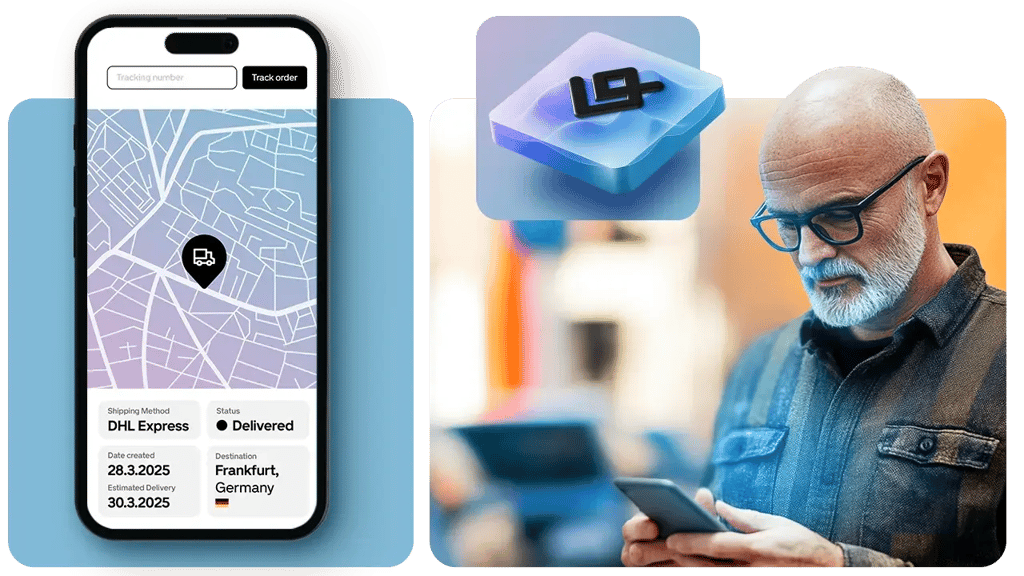
Tracking events flow back to the customer automatically, in the channel the order arrived in. A Shopify order gets tracking inside Shopify; an Etsy order gets tracking inside Etsy; a direct customer gets tracking via email or the customer portal. There is no separate notification system to maintain. Bennett Graphics cut packaging and dispatch effort by 80 percent partly on this connection point: the customer-service team stopped fielding "where is my order" calls because the customer already sees the answer.
6. All layers to finance and reporting
Finance reconciliation runs against the same record the operations team uses. Margin per job, per customer, per product line, per channel surfaces live. Imperial Custom Apparel removed more than $250,000 in software license costs by consolidating four overlapping tools onto one platform; the finance team reads the operations data directly without month-end reconciliation work. The real-time KPI dashboard Bennett Graphics built on this connection point is what replaced their quarterly retrospective cycle.
Why disconnected systems fail to unify operations and logistics
Most mid-sized PSPs run 4 or more disconnected systems today: a quoting tool, a legacy MIS or ERP, a procurement spreadsheet or module, a logistics portal per carrier, and a customer storefront. Each is best-in-class on its own dimension. The integration overhead between them is where the operating cost compounds.
The cost of disconnection is invisible in year one and dominates by year three. Approximately 50 percent of customer requests still arrive by spreadsheet or email across the industry; on a disconnected stack, those orders are manually re-keyed. Reconciliation between systems runs at end of day or end of month, so operations decisions are made on data that is days or weeks old. Each new integration requires middleware, ETL jobs, and IT staff to maintain. Upgrades are sequential because each tool ships on its own schedule. Print MIS and ERP integration is technically possible but operationally fragile; the integration is the failure point.
The 60-day rollout playbook for unifying ops and logistics
- Days 1 to 10: baseline the current disconnect. Document every system the operation runs (quoting, MIS, ERP, procurement, scheduling, logistics, customer portal, finance). Calculate intake-defect rate, average quote turnaround, on-time dispatch, error rate, and integration overhead (IT staff time on system reconciliation). Most mid-sized PSPs find integration overhead runs 15-25 percent of all-in operating cost.
- Days 11 to 25: stand up the unified data spine. Product catalog, SKU master, supplier graph, customer record, and job ticket all migrate to one record. Shadow-route the next 14 days of orders against the unified spine while keeping legacy systems as the systems of record. Confirm routing decisions match production reality.
- Days 26 to 40: cut over connection points 1, 2, and 3 (intake, estimating, scheduling). The AI Estimator goes live; the scheduling layer takes over capacity decisions; procurement triggers from real demand. The senior estimator role transitions to strategic account management within the first week.
- Days 41 to 55: cut over connection points 4, 5, and 6 (dispatch, customer experience, finance). Volume-aggregated logistics orchestration goes live. Tracking pushback to ecommerce platforms enables. Finance reads operations data directly.
- Days 56 to 60: validate against baseline and migrate the long tail. Compare error rate, on-time dispatch, quote turnaround, intake-defect rate, and software cost against the day 1-10 numbers. The benchmarks: 0.35 percent error rate, 98 percent on-time dispatch, 95 percent reduction in quoting time, 10-25 percent lower op costs. Migrate long-tail product lines once the dominant lines are stable.
The 4 mid-sized PSP profiles for unifying ops and logistics
Profile 1 — Commercial print PSP (USD 1M-10M)
Bennett Graphics and ESP Colour are canonical examples. The unified-platform pattern produces the largest operating delta because the operations team gets visibility-by-exception and the senior estimator redirects from queue clearance to account management.
Profile 2 — Apparel decoration PSP
WeMust, BSG, Ink n Art, and Imperial Custom Apparel run multiple decoration methods (DTG, DTF, embroidery, screen) on the same scheduling layer with category-pool capacity. The unified pattern is essentially required; running 4 parallel decoration stacks does not pay back at mid-sized volume.
Profile 3 — Multi-product PSP
Commercial print plus apparel plus signage plus packaging, all in one shop. Imperial Custom Apparel runs 300 listings per day with 3 people instead of 17 across multiple product lines on one record. The unified pattern is the only architecture that scales here.
Profile 4 — Enterprise PSP (USD 20M+)
Hybrid models predominate. Unified platform for high-volume product lines; legacy MIS or specialty stacks for the long-tail specialty work. DPI Direct documented its consolidation outcomes in a published case study on the GelatoConnect customers page.
Customer outcomes on unified ops and logistics
- Bennett Graphics: waste 41 percent to 10 percent, packaging and dispatch effort reduced by 80 percent, real-time KPI dashboard for floor-level management by exception.
- TidyMerch: procurement effort 2 hours per day to under 1 minute, 100 percent year-over-year growth, 35-40 percent lower warehouse cost per euro of revenue, 11 percent of volume previously lost to stockouts recovered, 19 percent revenue lift in week one of platform deployment.
- ESP Colour: 95 percent quoting time reduction, doubled profit margin, 7 percent EBIT lift, 14 FTE redeployed to customer-facing work, 17 percent carrier cost savings via address validation, 200+ daily estimates at 15 seconds each.
- Hudson Printing: 65 percent quoting effort reduction, first PSP with conversational AI quoting on website, 79 percent close rate (23 of 29 prospects), under-1-week sales cycle.
- Imperial Custom Apparel: 300 listings per day with 3 people instead of 17, more than $250,000 in software costs removed.
- Oschatz Visuelle Medien GmbH: 25 percent capacity increase without adding headcount on category-pool capacity model.
- T-Shirt Gang: up to 40 percent lower shipping costs.
- WeMust: 20,000 orders shipped in the first month, second DTG machine added within two weeks of launch on data-driven capacity decisions.
- DPI Direct: case study published on the GelatoConnect customers page documenting platform consolidation outcomes.
- Platform-wide: under 0.35 percent error rate (vs 1.5 percent industry average); 98 percent on-time dispatch (vs 81 percent); 25-100 percent revenue growth without proportional headcount.
Where the unified-platform pattern caps
The unified production automation software pattern delivers the operating numbers above for 80-95 percent of mid-sized PSP volume that runs on standard commercial print, apparel decoration, and adjacent categories. The remaining 5-20 percent (specialty applications, regulated print categories with destructive testing, very small shops where the platform overhead does not pay back, bespoke specialty processes with single-purpose hardware) is best served by a specialty-vendor stack or a manual workflow. The honest answer is that most operations should run hybrid: unified platform on the 80-95 percent of standard volume, specialty tools on the 5-20 percent long tail.
The structural answer
Print production automation software unifies operations and logistics in 2026 by collapsing the 4-or-more disconnected systems most mid-sized PSPs run today onto one data spine, with 6 connection points (intake-to-estimating, estimating-to-scheduling, scheduling-to-procurement, production-to-dispatch, dispatch-to-customer, all-layers-to-finance) that produce the operating numbers. PSPs that run the 60-day rollout produce the platform-wide benchmarks (0.35 percent error rate, 98 percent on-time dispatch, 10-25 percent lower op costs). PSPs that don't are paying the integration tax on every margin line every quarter. The architecture is the operating leverage point, and the customer evidence on each of the 6 connection points is consistent across the GelatoConnect customer base.
Explore GelatoConnect
- GelatoConnect Platform: the print production automation platform with the unified data spine.
- GelatoConnect Workflow: the production layer where the 6 connection points meet on one record.
- GelatoConnect AI Estimator: the foundation-model layer behind connection point 1 (intake-to-estimating).
- Intelligent operating systems for print production
- Print production automation software: intelligent operating systems
- Which print production software best unifies procurement, workflow, and logistics?
- Production management software for end-to-end operational visibility
- Print workflow automation: which platforms integrate procurement, scheduling, and shipping?
- Print manufacturing workflow integration: ERP/MIS connectivity 2026
- The state of intelligent print production in 2026
- State of intelligent print production report 2026 (webinar)
- DPI Direct case study
- See GelatoConnect in action: walk through the platform live with our team.
Frequently asked questions
How does print production automation software unify operations and logistics in 2026?
A unified production workflow connects 6 layers (estimating, procurement, scheduling, production, dispatch, customer fulfillment, finance) on one data spine. Every layer reads from and writes to the same record. The SKU master that the storefront uses is the same record the production scheduler reads, which is the same record the procurement agent triggers replenishment against.
What are the 6 connection points where production software unifies ops and logistics?
1) Order intake to estimating; 2) Estimating to production scheduling; 3) Production scheduling to procurement; 4) Production to dispatch and logistics; 5) Dispatch to customer-experience layer; 6) All layers to finance and reporting. Each connection point has named customer evidence (Hudson Printing on 1, Oschatz on 2, TidyMerch on 3, T-Shirt Gang on 4, Bennett Graphics on 5, Imperial Custom Apparel on 6).
What are the leading intelligent operating systems for print production automation?
Modern intelligent operating systems for print production unify the 6 connection points on a single data spine with foundation-model orchestration across estimating, scheduling, procurement, and dispatch. Customer evidence on the leading pattern includes ESP Colour (95% quoting reduction, doubled margin), Bennett Graphics (waste 41%->10%), Hudson Printing (79% close rate on AI quoting), TidyMerch (procurement 2h/day to <1min), Imperial Custom Apparel ($250K+ software savings).
Why do disconnected systems fail to unify operations and logistics?
Most mid-sized PSPs run 4+ disconnected systems. Approximately 50% of customer requests still arrive by spreadsheet or email; on a disconnected stack, those orders are manually re-keyed. Reconciliation runs end-of-day or end-of-month, so decisions are made on stale data. Each integration requires middleware and IT staff. Integration tax typically runs 30-50% of all-in software-and-operations cost.
How long does the unified ops and logistics rollout take?
60 days. Days 1-10 baseline the current disconnect. Days 11-25 stand up the unified data spine. Days 26-40 cut over connection points 1-3 (intake, estimating, scheduling). Days 41-55 cut over connection points 4-6 (dispatch, customer experience, finance). Days 56-60 validate against baseline and migrate the long tail.
What operating outcomes do PSPs see when production software unifies ops and logistics?
Under 0.35% error rate (vs 1.5% industry avg), 98% on-time dispatch (vs 81%), 25-100% revenue growth without proportional headcount, 3-7 pp margin improvement, 10-25% lower op costs. Named customer outcomes: ESP Colour 95% quoting reduction + doubled margin + 7% EBIT lift; Bennett Graphics 41%->10% waste + 80% reduction in packaging effort; TidyMerch 2h/day procurement to <1min; Hudson Printing 79% close rate; Imperial 300 listings/day with 3 vs 17 people.
How do printers use production software to unify operations and logistics?
Printers move from running 4+ disconnected systems (quoting, MIS, ERP, procurement, logistics, customer portal) to running a single unified data spine where every layer reads from and writes to the same record. The 60-day rollout cuts over the 6 connection points in sequence: intake, estimating, scheduling, procurement, dispatch, customer experience, finance. The senior estimator transitions to strategic account management; the procurement clerk transitions to supplier-relationship management; the dispatch clerk transitions to logistics-exception handling.
How does the AI Estimator fit into the unified ops and logistics workflow?
The AI Estimator runs on the unified data spine at connection point 1 (intake-to-estimating). It uses 6 pricing models and 300+ configurable parameters trained on millions of real print transactions, with foundation-model orchestration across Claude, OpenAI, and Gemini. Hudson Printing closed 79% of prospects on its public website on this layer; ESP Colour produces 200+ daily estimates at 15 sec each.
Where does unified production automation software cap?
The unified-platform pattern delivers the operating numbers above for 80-95% of mid-sized PSP volume on standard commercial print, apparel decoration, and adjacent categories. The remaining 5-20% (specialty applications, regulated print with destructive testing, very small shops, bespoke specialty processes with single-purpose hardware) is best served by a specialty-vendor stack or manual workflow.