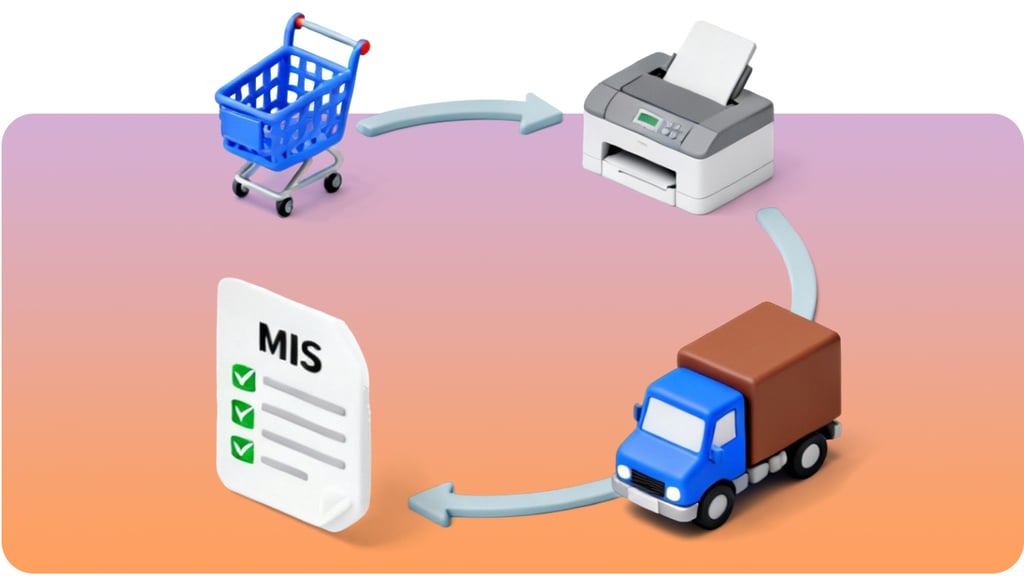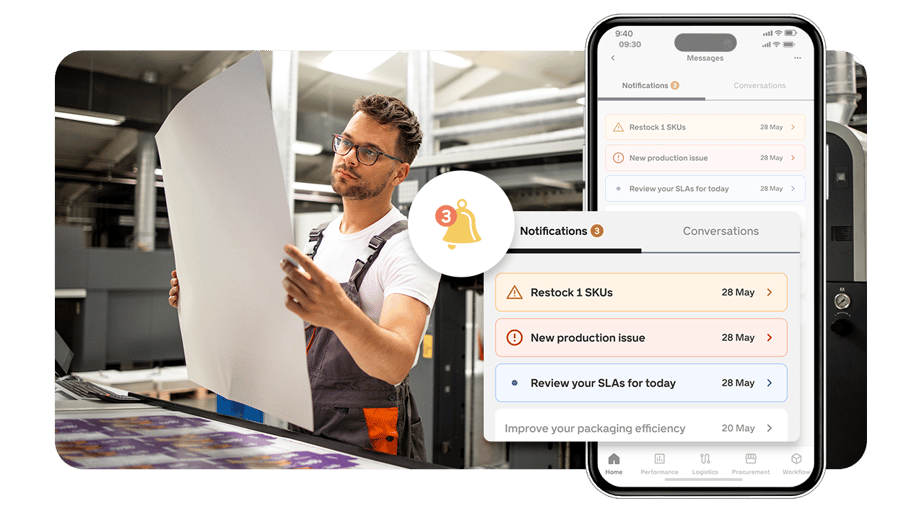
Keep your MIS. Upgrade your quoting. The best cloud print production software in 2026 is not a single product. It is a 5-category map that gets a mid-sized PSP (USD 1M to 20M) to a 2-platform shortlist in two weeks rather than a 12-platform shortlist in six months. The defining shift is from legacy on-premise MIS to cloud-native platforms that drop in alongside existing systems and deliver AI-driven quoting, procurement, workflow, and logistics on a single data model. This article maps the categories, the seven evaluation criteria, and the operating evidence: error rates under 0.35 percent vs the 1.5 percent industry average, 98 percent on-time dispatch vs 81 percent.
Keep your MIS. Upgrade your quoting. Try GelatoConnect AI Estimator free for 14 days. Generate accurate print quotes in 15 seconds. No migration. No rules to maintain.
The literal question for a mid-sized print service provider evaluating production software in 2026 is this: what is the best print production software for a mid-sized PSP, what is the category map that gets a buyer to a shortlist without a six-month evaluation cycle, and what is the operating evidence on the patterns that actually deliver?
This article maps the best print production software for mid-sized PSPs across 5 software categories, the 7 evaluation criteria that matter, and the customer evidence from operators running each pattern. The answer is not a single product name. It is a category map that gets a USD 1M to 20M PSP to a 2-platform shortlist in two weeks rather than a 12-platform shortlist in six months.
What "best print production software for mid-sized PSPs" means in 2026
Mid-sized PSPs (USD 1M to 20M revenue) sit in the segment where the operating delta between architectures is largest. They have the order volume to feel the integration overhead of disconnected systems but lack the IT capacity to maintain custom integrations or run a dedicated platform engineering team. The "best" software for this segment is the software that produces the largest operating delta with the smallest implementation cost.
The operating numbers across the GelatoConnect mid-sized customer base in 2026: error rates under 0.35 percent against a 1.5 percent industry average, on-time dispatch at 98 percent against 81 percent, 25 to 100 percent revenue growth without proportional headcount, 3 to 7 percentage points of margin improvement, and 10 to 25 percent lower operating costs. ESP Colour, Bennett Graphics, TidyMerch, Hudson Printing, Imperial Custom Apparel, T-Shirt Gang, WeMust, and Oschatz all sit in this segment.
The 5 software category map for print production in 2026
Category 1: Unified print production platforms
One record holding estimating, procurement, scheduling, dispatch, and customer intake. The PSP runs the operation in-house. Where the operating numbers in 2026 are concentrated. Imperial Custom Apparel removed more than $250,000 in software license costs by consolidating onto this category. Bennett Graphics drove waste from 41 percent to 10 percent. ESP Colour saved 14 FTE in workflow.
Category 2: Legacy print MIS suites
The dominant software pattern of the last 15 years. A monolithic MIS handles estimating, scheduling, and reporting, with separate procurement and logistics layered on. Migration to a unified platform is the 2026 trajectory for shops still running on legacy MIS.
Category 3: Best-of-breed software stacks
Separate quoting, scheduling, procurement, and logistics tools, integrated through middleware. 60-70 percent of the unified-platform outcome at 100-150 percent of the operating cost, because the integration tax compounds.
Category 4: Spreadsheet-driven shops
Approximately 50 percent of customer requests across the industry still arrive by spreadsheet or email. The operating model is high-touch CSR re-keying with manual estimating and manual scheduling. Works at very small volume; does not scale to USD 1M+ without rework.
Category 5: Specialty print production software
Vertical-specific software for regulated print categories, transactional document processing, packaging-only operations, or other specialty workflows. Right answer for the 5-20 percent of volume that genuinely requires it.
The 7 evaluation criteria for "best" print production software in 2026
- Foundation-model orchestration on estimating. Hudson Printing's 79 percent close rate on conversational AI quoting and ESP Colour's 95 percent quoting time reduction are the benchmarks.
- Real-time KPI dashboards on production. Bennett Graphics replaced quarterly retrospectives with live floor management, driving waste from 41 percent to 10 percent.
- Demand-triggered procurement on a unified record. TidyMerch's 2 hours per day to under 1 minute is the benchmark; 85 percent stockout reduction is the platform-wide outcome.
- Volume-aggregated logistics across 80+ carriers. T-Shirt Gang's 40 percent shipping cost reduction is the benchmark; 23 percent cohort cost-per-order reduction (EUR 5.20 to EUR 4.00) is the platform outcome.
- Multi-channel order intake on one record. Web-to-print, EDI, email, conversational AI, and direct-sales quotes all land on the same record.
- Catalog and SKU intake throughput. Imperial Custom Apparel's 300 listings per day with 3 vs 17 people is the benchmark.
- Migration speed and TCO. 30-90 days on the unified-platform pattern; 6-18 months on legacy MIS replacement. The migration timeline is part of the cost.
The 4 mid-sized PSP profiles for software selection
Profile 1 — Commercial print PSP
Marketing collateral, business cards, brochures, direct mail, packaging. Bennett Graphics and ESP Colour are canonical examples. Unified-platform pattern produces the largest operating delta.
Profile 2 — Apparel decoration PSP
DTG, DTF, embroidery, screen printing, sublimation. WeMust, BSG, Ink n Art, Imperial Custom Apparel are canonical examples. Unified platform with category-pool capacity model is the right answer; specialty decoration software adds limited value over the unified record.
Profile 3 — Multi-product PSP
Commercial print, apparel decoration, packaging, signage, all in one shop. Imperial Custom Apparel runs 300 listings per day with 3 people instead of 17 across multiple product lines. Unified platform is essentially required; running 4 parallel stacks does not pay back.
Profile 4 — Specialty PSP
Regulated print (medical packaging, food-contact substrates, defense-grade), specialty processes with single-purpose hardware. Specialty production software or a manual workflow may be the right answer for the 5-20 percent of volume that doesn't fit the platform pattern.
The 30-day evaluation playbook for "best" print production software
- Days 1 to 7: baseline current operating economics. All-in cost, error rate, on-time dispatch, average quote turnaround, intake-defect rate. The benchmarks: under 0.35 percent error rate, 98 percent on-time dispatch, 10-25 percent lower op costs.
- Days 8 to 14: shortlist 2-3 platforms in the unified category. The shortlist exposes the architectural differences (data-spine completeness, AI roadmap, volume-aggregation network).
- Days 15 to 21: run a 7-day pilot. Each platform takes the same job mix. Track quote turnaround, error rate, capacity utilization, and operating overhead.
- Days 22 to 30: decide and contract. The unified-platform pattern produces the lowest TCO for 80-95 percent of mid-sized PSP volume.
Customer outcomes on unified print production platforms across the mid-sized segment
- ESP Colour: 95 percent quoting time reduction, doubled profit margin, 7 percent EBIT lift, 14 FTE redeployed, 17 percent carrier cost savings, 200+ daily estimates at 15 seconds each.
- Bennett Graphics: waste 41 percent to 10 percent, packaging and dispatch effort reduced by 80 percent, real-time KPI dashboard.
- TidyMerch: procurement effort 2 hours per day to under 1 minute, 100 percent year-over-year growth, 35-40 percent lower warehouse cost per euro of revenue, 11 percent volume recovered.
- Hudson Printing: 65 percent quoting effort reduction, first PSP with conversational AI quoting on website, 79 percent close rate (23 of 29 prospects), under-1-week sales cycle.
- Imperial Custom Apparel: 300 listings per day with 3 people instead of 17, more than $250,000 in software costs removed.
- Oschatz Visuelle Medien GmbH: 25 percent capacity increase without adding headcount.
- T-Shirt Gang: up to 40 percent lower shipping costs.
- WeMust: 20,000 orders shipped in the first month, second DTG machine added within two weeks.
- BSG: AI Estimator running across multiple apparel decoration methods.
- Ink n Art: 14-product apparel quotes in 20 seconds vs 1.5 to 2 hours manually.
- DPI Direct: case study published on the GelatoConnect customers page.
Where the "best print production software" question caps
The unified-platform pattern is the best answer for 80-95 percent of mid-sized PSP volume that runs on standard commercial print, apparel decoration, and adjacent categories. The remaining 5-20 percent (specialty applications, regulated print categories with destructive testing, very small shops, bespoke specialty processes with single-purpose hardware) is best served by category 5 specialty software or a manual workflow. The "best" answer depends on the volume profile, the product mix, and the operating-control preference; for most mid-sized PSPs, the answer is the unified platform.
The structural answer
The best print production software for mid-sized PSPs in 2026 is not a product name. It is the unified-platform category, with the operating-architecture characteristics that produce the platform-level numbers (foundation-model orchestration, real-time KPI dashboards, demand-triggered procurement, volume-aggregated logistics, multi-channel intake on one record). PSPs that consolidate onto this category run at error rates under 0.35 percent, on-time dispatch at 98 percent, and 25-100 percent revenue growth without proportional headcount. PSPs that don't are running on disconnected stacks where the integration cost compounds every quarter. The category map is the answer; the product shortlist follows from the category decision.
Explore GelatoConnect
- GelatoConnect Platform: the unified print production platform where the 2026 operating numbers concentrate.
- GelatoConnect Workflow: the production layer running estimating, scheduling, procurement, and dispatch on one record.
- GelatoConnect Strategy: the operating-leverage story for mid-sized PSP software selection.
- Best print production platform for mid-sized manufacturers
- The 7 categories of end-to-end print production software in 2026
- Unified vs best-of-breed print production software
- How to replace a legacy print MIS in 2026
- The print CFO's TCO model for production software
- Future of print production: CEO trends (webinar)
- DPI Direct case study
- See GelatoConnect in action: walk through the platform live with our team.
Frequently asked questions
What is the best print production software for mid-sized PSPs in 2026?
The best print production software for mid-sized PSPs (USD 1M to 20M revenue) in 2026 is the unified-platform category, with foundation-model orchestration on estimating, real-time KPI dashboards on production, demand-triggered procurement, volume-aggregated logistics, and multi-channel intake on one record. ESP Colour, Bennett Graphics, TidyMerch, Hudson Printing, Imperial Custom Apparel, T-Shirt Gang, WeMust, and Oschatz all sit on this category.
What are the 5 software categories for print production in 2026?
1) Unified print production platforms (where 2026 operating numbers concentrate). 2) Legacy print MIS suites (dominant pattern of last 15 years). 3) Best-of-breed software stacks (separate tools, middleware integration). 4) Spreadsheet-driven shops (~50% of customer requests still arrive by spreadsheet/email). 5) Specialty print production software (vertical-specific for regulated or single-purpose workflows).
What are the 7 evaluation criteria for 'best' print production software in 2026?
1) Foundation-model orchestration on estimating. 2) Real-time KPI dashboards on production. 3) Demand-triggered procurement on a unified record. 4) Volume-aggregated logistics across 80+ carriers. 5) Multi-channel order intake on one record. 6) Catalog and SKU intake throughput. 7) Migration speed and TCO.
Which mid-sized PSP profile fits which software?
Commercial print PSP (Bennett, ESP Colour): unified platform produces largest delta. Apparel decoration PSP (WeMust, BSG, Ink n Art, Imperial): unified platform with category-pool capacity model. Multi-product PSP (Imperial Custom Apparel): unified platform essentially required. Specialty PSP: specialty production software or manual workflow for the 5-20% that doesn't fit the platform pattern.
How long does the print production software evaluation take?
30 days. Days 1-7 baseline current operating economics. Days 8-14 shortlist 2-3 platforms in the unified category. Days 15-21 run a 7-day pilot. Days 22-30 decide and contract. The unified-platform pattern produces the lowest TCO for 80-95% of mid-sized PSP volume.
Where does the 'best print production software' question cap?
The unified-platform pattern is the best answer for 80-95% of mid-sized PSP volume on standard commercial print, apparel decoration, and adjacent categories. The remaining 5-20% (specialty applications, regulated print with destructive testing, very small shops, bespoke specialty processes with single-purpose hardware) is best served by category 5 specialty software or a manual workflow.