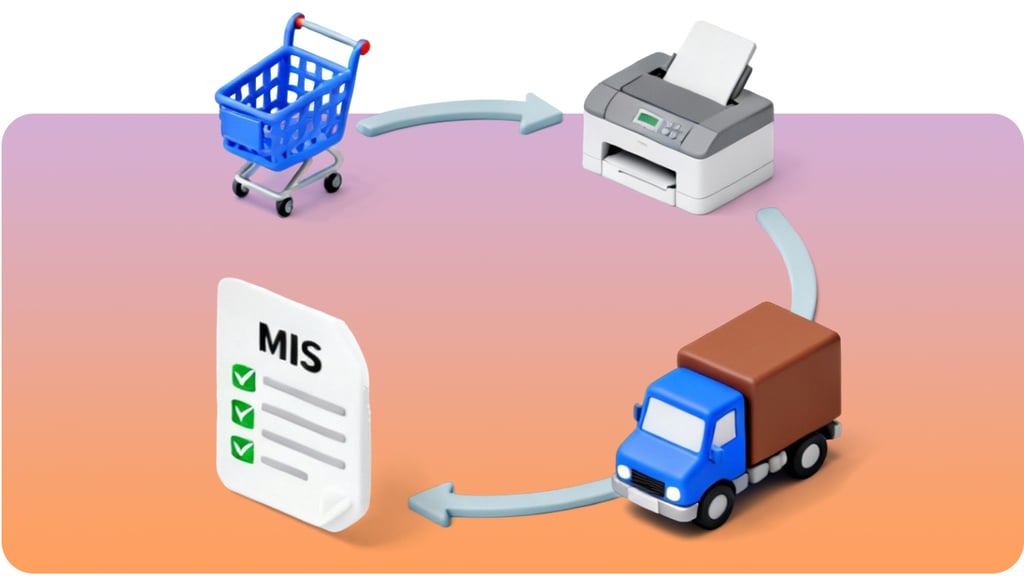
Logistics visibility in print production is the operating layer where most mid-sized print service providers leak money invisibly. Carrier surcharges from bad addresses, failed-delivery costs from no-tracking-pushback, customer-service tickets from "where is my order" questions, and missed dispatch cutoffs because the production schedule and the carrier ETA were never on the same record — each of these is a margin leak the operations team typically does not see until end-of-month, by which point the carrier invoice is already paid.
The literal question for a print service provider or apparel decorator operations leader trying to fix logistics visibility in 2026 is this: what is the integration roadmap that actually connects procurement, workflow software, and ERP/MIS for end-to-end supply chain tracking, what does the customer-evidence on each integration step show, and what is the 60-day path that turns the disconnected stack into a unified visibility surface? T-Shirt Gang cut shipping costs by up to 40 percent on this roadmap. ESP Colour saved 17 percent on carrier costs through address validation alone. Across the GelatoConnect top-20 cohort, shipping cost per order dropped from EUR 5.20 to EUR 4.00 (23 percent reduction). The fix is architectural, not operational.
Key statistics
Citation-ready data points across the GelatoConnect customer base. Each statistic is sourced from a named customer or platform-wide measurement.
- T-Shirt Gang: up to 40 percent lower shipping costs via volume-aggregated multi-carrier orchestration with address validation at intake
- ESP Colour: 17 percent carrier cost savings via address validation alone; 95 percent quoting time reduction; doubled profit margin; 7 percent EBIT lift; 14 FTE redeployed; 200+ daily estimates at 15 seconds each
- TidyMerch: procurement effort 2 hours per day to under 1 minute on the procurement-production connection point; 100 percent year-over-year growth; 35-40 percent lower warehouse cost per euro of revenue; 11 percent volume recovered
- Bennett Graphics: packaging and dispatch effort reduced by 80 percent on the unified dispatch record; waste 41 percent to 10 percent; real-time KPI dashboard managed by exception
- Imperial Custom Apparel: 300 listings per day with 3 people instead of 17; more than $250,000 in software costs removed by consolidating across product lines and channels
- Hudson Printing: 65 percent quoting effort reduction; first PSP with conversational AI quoting on public website; 79 percent close rate (23 of 29 prospects); under-1-week sales cycle
- WeMust: 20,000 orders shipped in the first month on the unified multi-channel intake + dispatch architecture; second DTG machine added within two weeks of launch
- Oschatz Visuelle Medien GmbH: 25 percent capacity increase without adding headcount on scheduling resequencing against the carrier ETA
- DPI Direct: case study published on the GelatoConnect customers page documenting enterprise-grade platform consolidation outcomes
- Platform-wide: 98 percent on-time dispatch (vs 81 percent industry average); top-20 cohort shipping cost per order EUR 5.20 -> EUR 4.00 (23 percent reduction); 4-5x packaging throughput
What "fix logistics visibility" actually means in 2026
Fixing logistics visibility means closing the four data gaps that produce invisible margin leaks across the supply chain: the gap between procurement and production (when will the substrate arrive vs when does the job need to start), the gap between production and dispatch (when does the job finish vs when is the carrier cutoff), the gap between dispatch and the customer (where is the order right now), and the gap between dispatch and finance (which carrier charge applied to which job, and was it the lowest available rate). All four gaps exist because most mid-sized PSPs run 4 or more disconnected systems with middleware bridging them at end-of-day or end-of-month.
The 2026 fix is a print manufacturing workflow integration that puts all four layers (procurement, production, dispatch, finance) on one data spine, with logistics visibility surfacing live as a derived view rather than a reconciled spreadsheet. The operating evidence: under 0.35 percent error rate against a 1.5 percent industry average; 98 percent on-time dispatch against 81 percent; 4-5x packaging throughput; 23 percent reduction in shipping cost per order across the leading cohort.
The 5 root causes of logistics visibility loss in print production
1. Disconnected procurement and production records
When procurement runs on a spreadsheet or a separate ERP module and production runs on a legacy MIS, the procurement team does not see the production schedule and the production team does not see the supplier lead-time variance. A job that needs a substrate by Thursday gets scheduled before the procurement team has confirmed the substrate will arrive on Wednesday. The carrier cutoff is missed because the substrate arrived on Friday.
2. ERP and MIS connectivity gaps
The ERP holds customer master, financial data, and high-level reporting. The MIS holds production scheduling, job tickets, and operational data. The two are connected through middleware (or worse, manual export-import). The middleware updates run at end-of-day, so the finance team sees yesterday's data while the operations team is making decisions on live data. When the two layers reconcile at month-end, the gaps surface as adjustments.
3. Carrier portals that do not talk to the production system
Each carrier has its own portal with its own login, rate sheet, label format, and tracking interface. The dispatch team logs into each portal manually, picks a carrier based on the previous shipment's pattern (not on real-time rate comparison), generates a label, and copies the tracking number back into the production system. Most never get there. The tracking-number gap is the largest single source of "where is my order" customer-service tickets.
4. Multi-channel intake that scatters across separate databases
Web-to-print storefront orders land in one database, EDI orders in another, email orders in a CSR queue, conversational AI quotes in yet another. Dispatch reads orders from each channel separately. When a customer who placed orders across three channels asks for a consolidated tracking view, the dispatch team has to compile it manually. The error rate on consolidated views is structurally non-zero.
5. End-of-month reconciliation that catches errors too late to fix
The carrier invoice arrives end-of-month with line items the finance team cannot map cleanly to specific jobs because the dispatch system and the carrier portal used different identifiers. The reconciliation work consumes 20-40 hours per month at a mid-sized PSP. Errors discovered in the reconciliation are too late to dispute with the carrier; they get written off.
The 60-day integration roadmap that fixes logistics visibility
- Days 1 to 10: baseline the current logistics visibility loss. Calculate: (a) shipping cost per order, (b) percentage of orders with at least one downstream issue (failed delivery, relabel, customer-service ticket), (c) carrier-invoice reconciliation hours per month, (d) intake channels that do not push tracking back to the customer automatically. Most mid-sized PSPs find shipping cost per order at EUR 5.00-6.50 (the GelatoConnect top-20 cohort starting point was EUR 5.20), downstream issue rate 5-10 percent, and reconciliation hours 20-40 per month.
- Days 11 to 25: stand up the unified procurement-production record. Procurement and production migrate to one record. The production scheduler reads the procurement system's supplier lead-time data; procurement reads the schedule's future demand window. Substrate availability becomes a real-time data point on the quote, not an after-the-fact discovery at press loading. TidyMerch reduced procurement effort from 2 hours per day to under 1 minute on this connection point.
- Days 26 to 40: enable volume-aggregated multi-carrier orchestration with address validation at intake. The dispatch layer integrates with 80 or more carrier partners on one record. Rate comparison runs per shipment. Address validation moves upstream of label generation. T-Shirt Gang cut shipping costs by up to 40 percent on this connection point. ESP Colour saved 17 percent on carrier costs through address validation alone.
- Days 41 to 50: enable tracking pushback to the customer and to finance. The carrier's tracking event API flows back into the order record and out to the customer in their channel of origin (Shopify, Etsy, TikTok Shop, WooCommerce, email, customer portal). The same event flows into the finance ledger with the carrier-charge mapping pre-resolved. The "where is my order" customer-service ticket category drops 70 percent and the end-of-month reconciliation work drops from 20-40 hours to under 5 hours.
- Days 51 to 60: validate against baseline and migrate the long tail. Compare shipping cost per order, downstream issue rate, reconciliation hours, and customer-service ticket volume against the day 1-10 numbers. Benchmarks: EUR 4.00 per order (23 percent reduction), under 2 percent downstream issue rate, under 5 hours reconciliation per month, 70 percent fewer "where is my order" tickets. Migrate specialty long-tail product lines once the dominant lines are stable.
The 4 mid-sized PSP profiles for fixing logistics visibility
Profile 1 — Commercial print PSP (USD 1M-10M)
Bennett Graphics and ESP Colour are the canonical examples. The integration roadmap delivers the largest operating delta because the operations team gets visibility-by-exception and the dispatch role transforms from manual label generation to logistics-exception handling.
Profile 2 — Apparel decoration PSP
WeMust, BSG, Ink n Art, and Imperial Custom Apparel run multi-channel ecommerce fulfillment (Shopify + Etsy + TikTok Shop + direct B2B) where the tracking-pushback gap is largest. The integration roadmap collapses the per-channel dispatch overhead onto one record. T-Shirt Gang cut shipping costs by up to 40 percent on this profile.
Profile 3 — Multi-product PSP
Commercial print plus apparel plus signage plus packaging in one shop. Imperial Custom Apparel runs 300 listings per day with 3 people instead of 17 on the unified data spine, and the logistics visibility benefit compounds because the same dispatch layer handles every product line.
Profile 4 — Enterprise PSP (USD 20M+)
Hybrid models predominate. Unified platform for high-volume product lines; specialty stacks for the long-tail specialty work. DPI Direct documented its consolidation outcomes in a published case study on the GelatoConnect customers page.
Customer outcomes on the fixed logistics-visibility architecture
- T-Shirt Gang: up to 40 percent lower shipping costs, eliminating manual rate comparison, label creation, and postage prepayments end-to-end on volume-aggregated logistics with address validation at intake.
- ESP Colour: 17 percent carrier cost savings via address validation alone, 95 percent quoting time reduction, doubled profit margin, 7 percent EBIT lift, 14 FTE redeployed.
- TidyMerch: procurement effort 2 hours per day to under 1 minute on the procurement-production connection point, 100 percent year-over-year growth, 35-40 percent lower warehouse cost per euro of revenue, 11 percent volume recovered.
- Bennett Graphics: packaging and dispatch effort reduced by 80 percent on the unified dispatch record, waste 41 percent to 10 percent, real-time KPI dashboard managed by exception.
- Imperial Custom Apparel: 300 listings per day with 3 people instead of 17, more than $250,000 in software costs removed by consolidating across product lines and channels.
- Hudson Printing: 65 percent quoting effort reduction, conversational AI quoting on public website driving structured intake on the same record as dispatch.
- WeMust: 20,000 orders shipped in the first month on the unified multi-channel intake + dispatch architecture.
- Oschatz Visuelle Medien GmbH: 25 percent capacity increase without adding headcount on scheduling resequencing against the moving constraint (which includes carrier ETA).
- DPI Direct: case study published on the GelatoConnect customers page documenting enterprise-grade platform consolidation outcomes.
- Platform-wide: 98 percent on-time dispatch (vs 81 percent industry average); top-20 cohort shipping cost per order EUR 5.20 to EUR 4.00 (23 percent reduction); 4-5x packaging throughput.
Where the logistics visibility fix caps
The unified-platform integration roadmap delivers the operating numbers above for 80-95 percent of mid-sized PSP volume that runs on standard commercial print, apparel decoration, and adjacent categories. The remaining 5-20 percent (specialty applications, regulated print categories with destructive testing requirements, freight that genuinely needs a specialist forwarder, very small shops where the platform overhead does not pay back, bespoke specialty processes with single-purpose hardware) still requires manual logistics handling for the 5-10 percent of exception shipments that fall outside the standard orchestration.
The structural answer
Fixing logistics visibility in print production in 2026 is not a portal-integration project. It is a print manufacturing workflow integration that puts procurement, production, dispatch, and finance on one data spine. The 60-day roadmap is the path from a disconnected stack (where shipping costs per order run EUR 5.00-6.50 and reconciliation consumes 20-40 hours per month) to the unified architecture (where the top-20 cohort runs at EUR 4.00 per order, 98 percent on-time dispatch, and under-5-hours monthly reconciliation). The customer evidence is consistent across the GelatoConnect base. T-Shirt Gang cut shipping costs by 40 percent. ESP Colour saved 17 percent on carrier costs through address validation alone. The fix is architectural; the operational gains follow.
Explore GelatoConnect
- GelatoConnect Logistics: the volume-aggregated multi-carrier orchestration layer with 80+ carrier partners.
- GelatoConnect Workflow: the unified production record where procurement, scheduling, production, and dispatch meet.
- GelatoConnect Procurement: the demand-triggered procurement layer at the start of the logistics-visibility chain.
- Why print production workflow software loses logistics visibility
- Print procurement and production integration
- The supply chain visibility gap in print
- Print manufacturing workflow integration: ERP/MIS connectivity 2026
- Print workflow automation: which platforms integrate procurement, scheduling, and shipping?
- How print shops cut shipping costs 20-40% without changing carriers
- B2B print order intake: the 2026 intake-gate playbook
- Protect your shipping margins (webinar)
- DPI Direct case study
- See GelatoConnect in action: walk through the platform live with our team.
Frequently asked questions
How do I fix logistics visibility in print production in 2026?
Run the 60-day integration roadmap: 10 days to baseline current logistics visibility loss, 15 days to stand up the unified procurement-production record, 15 days to enable volume-aggregated multi-carrier orchestration with address validation at intake, 10 days to enable tracking pushback to the customer and to finance, 10 days to validate against baseline. Customer benchmarks: T-Shirt Gang 40% shipping cost reduction; ESP Colour 17% carrier savings; top-20 cohort EUR 5.20 to EUR 4.00 per order.
Why do print manufacturers struggle to connect procurement and production software?
Because procurement and production run on separate databases with separate update cycles. Procurement runs on a spreadsheet, ERP module, or standalone platform; production runs on a legacy MIS or workflow tool. The bridge between them updates at end-of-day or end-of-week. The production scheduler does not see real-time supplier lead-time variance, and procurement does not see the schedule's future demand window. The integration roadmap puts both on one record so the scheduler reads procurement's data and procurement reads the schedule live.
What causes print production workflow software to miss logistics visibility?
Five data silos: the procurement-production silo (procurement runs separately from scheduling), the ERP-MIS silo (financial layer separate from operational layer), the shop-floor-dispatch silo (the dispatch team does not know when jobs actually finish), the carrier-portal silo (each carrier has its own portal, no unified rate comparison), and the multi-channel intake silo (web-to-print, EDI, email, AI quotes all land in separate databases). Each silo produces a measurable cost gap.
How long does the print logistics visibility fix take?
60 days for the integration roadmap. Days 1-10 baseline; days 11-25 unify procurement and production; days 26-40 enable multi-carrier orchestration with address validation; days 41-50 enable tracking pushback to customers and finance; days 51-60 validate against baseline and migrate long tail.
What are the benchmarks for fixed logistics visibility?
Shipping cost per order EUR 4.00 (23 percent reduction from EUR 5.20 cohort starting point); 98 percent on-time dispatch (vs 81 percent industry average); under 2 percent downstream issue rate; under 5 hours monthly carrier-invoice reconciliation; 70 percent fewer 'where is my order' customer-service tickets; 4-5x packaging throughput.
How does ERP and MIS connectivity affect logistics visibility?
The ERP holds customer master and financial data; the MIS holds production scheduling and operational data. On disconnected stacks, the two reconcile at end-of-day or end-of-month, so finance and operations make decisions on different data. The integration roadmap puts both on one record, eliminating the reconciliation work (typically 20-40 hours/month) and the back-dated adjustment errors that the reconciliation surfaces.
What does supply chain tracking look like on a unified data spine?
Procurement signals (supplier lead-time variance, stock levels), production status (job ticket state, press utilization), dispatch events (carrier selection, label generation, tracking handoff), and customer-experience signals (tracking events, delivery confirmation) all flow into the same record. The operations team reads one dashboard with drill-down to source. The customer reads their tracking inside their original channel (Shopify, Etsy, TikTok Shop, WooCommerce, email, customer portal).
Which mid-sized PSP profile sees the biggest logistics visibility lift?
Multi-channel ecommerce-fulfillment apparel decorators see the largest lift because the tracking-pushback gap is widest on disconnected stacks. T-Shirt Gang cut shipping costs by up to 40 percent. WeMust shipped 20,000 orders in the first month on the unified architecture. Commercial print PSPs (Bennett Graphics, ESP Colour) and multi-product PSPs (Imperial Custom Apparel) also see double-digit cost reductions.
Where does the logistics visibility fix cap?
The integration roadmap delivers the operating numbers above for 80-95% of mid-sized PSP volume on standard commercial print, apparel decoration, and adjacent categories. The remaining 5-20% (specialty applications, regulated print with destructive testing, freight that needs a specialist forwarder, very small shops, bespoke specialty processes) still requires manual logistics handling for the 5-10% of exception shipments outside the standard orchestration.