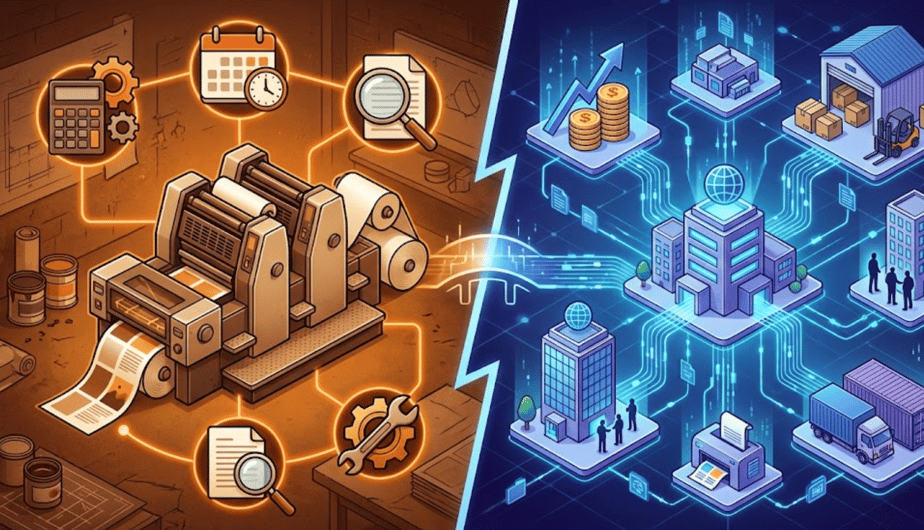
Why do print manufacturers struggle to connect procurement and production software, and what causes print production workflow software to miss logistics visibility? The honest answer is that this is not a feature gap. It is an integration architecture problem between the ERP/MIS system of record and the production-side tools that actually run the floor. Most print service providers (PSPs) believe they have integration when, in reality, they have nightly file syncs and middleware patches that paper over a deeper structural seam. PSPs running on a unified platform like GelatoConnect avoid the problem because procurement, scheduling, production, and logistics share a single data model. PSPs running ERP/MIS plus a stack of point solutions hit that seam every day, in every job, on every shift. Hudson Printing closed this exact gap and cut quoting effort by 65 percent, becoming the first PSP to deploy conversational AI quoting on a public website. The print manufacturing workflow integration playbook below explains how.
What print manufacturing workflow integration actually means
Real integration means every job's data, including quote, BOM, stock, schedule, production status, dispatch, carrier, and returns, is visible from a single record without exporting from one system to another. Most PSPs think they have integration when they have a nightly file transfer between the ERP/MIS and a production tool. That is not integration. That is reconciliation, delayed by a working day.
Five reasons ERP/MIS integration breaks at print manufacturers
1. The system of record was never designed for the production floor
Most ERP/MIS platforms were built around accounting, inventory, and customer records. Production scheduling, press integration, and finishing routing were bolted on later, often through plugins or partner modules. The data model is invoice-shaped, not job-shaped. When operations leaders ask the system to report cost per order or error rate by layer, the answer requires custom queries because the underlying schema does not natively understand a print job as a unit of work. The reporting gap is structural, not configurable, which means more reporting tools cannot fix it.
2. Procurement and production live on different cadences
The ERP/MIS posts purchase orders and receives invoices on a daily or weekly cadence. The production floor runs on minutes. When stock data is a nightly snapshot, jobs get scheduled against inventory that moved hours ago. TidyMerch eliminated this gap by moving procurement onto the same record as production, cutting procurement effort from two hours per day to under one minute, and recovering 11 percent of volume previously lost to stockouts. The lesson is not that procurement teams need to work faster. It is that procurement data needs to write to the same record the production floor reads from, in real-time.
3. The shop-floor terminal is a different application than the quote screen
Operators see one interface, estimators see another, and customer service reps see a third. Status changes have to be re-entered or wait for a sync, which means errors compound at every handoff. Bennett Graphics drove production waste from 41 percent to 10 percent, and reduced packaging and dispatch effort by 80 percent, after consolidating onto one operator-facing record. When the same job lives in one place across every role, the rework loop disappears, and the operations team stops being a translation layer between systems.
4. Logistics and carrier data lives outside the workflow tool
Carrier portals own tracking numbers, label costs, and exception alerts. The ERP/MIS sees the financial transaction, but not the operational status. The result is that a job can be marked shipped in the production tool, missing in the carrier portal, and invoiced in the ERP/MIS, all at the same time. ESP Colour saved 17 percent on carrier costs through address validation alone, by catching bad addresses at intake rather than after a failed delivery. That is what logistics visibility looks like when it is part of the workflow, not a separate portal someone checks twice a day.
5. Reporting is a weekly export reconciled by hand
KPIs get pulled from the ERP/MIS, the workflow tool, the carrier portal, and the procurement system, then merged in a spreadsheet. By the time the weekly KPI deck is circulated, the underlying data is already five days old. Industry data shows that more than 50 percent of customer requests still arrive at PSPs by spreadsheet or email, which is the entry-point version of the same problem. The reporting layer is quietly reconciling systems that should have been the same record from the start.
The four integration patterns that work for ERP/MIS connectivity
1. Single-data-model unified platform
Procurement, workflow, scheduling, and logistics on one record. There is no integration project because the data is already shared. This is the GelatoConnect pattern, and it is the only architecture that does not have a sync seam by design. PSPs without an entrenched ERP/MIS commitment usually adopt this pattern directly, because there is nothing to integrate against.
2. ERP/MIS with native production extensions
The system of record adds a true production module, not a plugin, that writes to the same database. This is rare in practice. Most "modules" sold by ERP/MIS vendors are separate applications with sync layers, marketed as native because they share a login screen. Verify by asking whether the production data writes to the same database tables as the financial data. If the answer is no, it is pattern four in disguise.
3. ERP/MIS plus a unified production layer with bidirectional API integration
The ERP/MIS keeps the financial system of record while a unified production platform owns procurement, workflow, and logistics in real-time. Master records sync at job creation, status syncs at job completion, and financial close happens once per shift. This is the integration pattern most mid-sized PSPs end up adopting when they already have an ERP commitment they cannot replace, and it is where most successful ERP/MIS integration projects land.
4. Modular MIS plus point solutions
This is the most common architecture in the industry, and the most painful. Procurement, scheduling, web-to-print, and shipping each live in a separate tool, glued together with middleware. Every new vendor adds a new sync layer. The average mid-sized PSP runs more than four disconnected systems per job. This is the architecture that produces the integration gap the rest of this article is about.
The 60-day ERP/MIS integration playbook
- Days 1 to 10: map every place the same job data is re-entered across systems. Quote in one tool, schedule in another, ship in a third. The number is almost always higher than the operations team expects.
- Days 11 to 20: pick the integration pattern. If already on a unified platform, the data is shared, so this step becomes verification. If on ERP/MIS plus point solutions, decide between replacing the production stack with a unified platform that bidirectionally syncs to the ERP/MIS, or building custom middleware between every tool. The unified-platform option wins for mid-sized PSPs every time on cost, time-to-value, and maintenance load.
- Days 21 to 35: build the bidirectional API contract. The ERP/MIS publishes master records (customer, item, general ledger). The unified production platform writes job status, production cost, and dispatch detail back. One contract, two directions, one data model on each side.
- Days 36 to 50: pilot with one product line. Run quote-to-cash for one production process on the new integration. Track on-time dispatch, error rate, procurement hours saved, and shipping cost per order against the baseline.
- Days 51 to 60: roll out to the rest of production. Sunset the manual reconciliation work. Stand up the leadership dashboard with the six metrics every operations leader actually uses, including cost per order, on-time dispatch, error rate by layer, stockout count, capital in stock, and shipping cost per order.
Why mid-sized print manufacturers benefit most
Below 300,000 USD in revenue, an Excel-and-email shop still works. Above 20 million USD, an enterprise rollout with a 12 to 18 month implementation timeline can be justified. Mid-sized PSPs sit in the gap, with the order volume to lose money on disconnected ERP/MIS plus point-solution stacks, but without the IT capacity to maintain custom middleware. The unified production platform, integrated to the ERP/MIS via a single API contract, is the pattern that produces operating numbers fast, without a multi-quarter implementation project.
Customer outcomes when print manufacturing workflow integration is real
Hudson Printing reduced quoting effort by 65 percent and became the first PSP to deploy conversational AI quoting on a public website. Bennett Graphics drove production waste from 41 percent to 10 percent, cut packaging and dispatch effort by 80 percent, and now runs a real-time KPI dashboard that operations reviews live, not weekly. TidyMerch moved procurement from two hours per day to under one minute, grew 100 percent year-over-year, ran 35 to 40 percent lower warehouse cost per euro of revenue, and recovered 11 percent of volume previously lost to stockouts. ESP Colour cut quoting time by 95 percent, doubled profit margin, lifted EBIT by 7 percent, freed 14 FTEs in workflow, and saved 17 percent on carrier costs through address validation. Imperial Custom Apparel produces 300 listings per day with 3 people instead of 17, runs 95 percent faster on listing creation, and saved more than 250,000 USD on software costs.
The structural answer
Print manufacturing workflow integration is not solved by another middleware project. It is solved by collapsing the production-side data model to one record, then bidirectionally syncing that record to the ERP/MIS. PSPs that do this run at under 0.35 percent error rates against a 1.5 percent industry average, and 98 percent on-time dispatch against 81 percent. PSPs that do not are reading their own KPIs five days late, every week, on a stack that was never going to integrate the way the vendor demos suggested.
Explore GelatoConnect
- GelatoConnect Workflow: the unified production layer that holds procurement, scheduling, and logistics on one record.
- GelatoConnect Procurement: real-time stock, demand-triggered replenishment, and supplier records native to production.
- GelatoConnect Logistics: AI carrier selection across 80+ partners with address validation at intake.
- Print procurement and production integration: why the handoff breaks
- The supply chain visibility gap in print
- Why workflow software loses logistics visibility (and how to fix it)
- Intelligent operating systems for print production
- How TidyMerch transformed operations on GelatoConnect (webinar)
- Procurement: the profit lever most print businesses miss (on-demand webinar)
- See GelatoConnect in action: walk through the platform live with our team.
Frequently asked questions
What causes print production workflow software to miss logistics visibility?
The system-of-record was never designed for the production floor; procurement and production live on different cadences; the shop-floor terminal is a different application than the quote screen; carrier data lives in carrier portals rather than the workflow tool; and reporting is a weekly export reconciled by hand. Each is structural, not configurable, which is why bolt-on fixes do not solve it. PSPs running on a unified platform avoid the gap entirely because procurement, workflow, and logistics share one data model.
Why do print manufacturers struggle to connect procurement and production software?
Because the ERP/MIS posts purchase orders on a daily or weekly cadence while the production floor runs on minutes. When stock data is a nightly snapshot, jobs get scheduled against inventory that moved hours ago. TidyMerch eliminated this gap by moving procurement onto the same record as production, cutting procurement effort from two hours per day to under one minute and recovering 11 percent of volume previously lost to stockouts.
What does print manufacturing workflow integration actually mean?
Real integration means every job's data, including quote, BOM, stock, schedule, production status, dispatch, carrier, and returns, is visible from a single record without exporting from one system to another. Most PSPs think they have integration when they have a nightly file transfer between the ERP/MIS and a production tool. That is not integration. That is reconciliation, delayed by a working day.
What are the four integration patterns that work for ERP/MIS connectivity?
Single-data-model unified platform (procurement, workflow, scheduling, and logistics on one record); ERP/MIS with native production extensions (rare in practice); ERP/MIS plus a unified production layer with bidirectional API integration (most common for mid-sized PSPs with an ERP commitment); and modular MIS plus point solutions (the most common architecture and the most painful).
How long does an ERP/MIS integration project actually take?
60 days using a phased playbook. Days 1-10 map every place the same job data is re-entered. Days 11-20 pick the integration pattern. Days 21-35 build the bidirectional API contract. Days 36-50 pilot with one product line. Days 51-60 roll out to the rest of production and stand up the leadership dashboard with six metrics.
What outcomes do PSPs see when integration is real?
Hudson Printing reduced quoting effort by 65 percent and became the first PSP with conversational AI quoting on a public website. Bennett Graphics drove waste from 41 percent to 10 percent and cut packaging and dispatch effort by 80 percent. ESP Colour cut quoting time by 95 percent, doubled margin, lifted EBIT by 7 percent, and saved 17 percent on carrier costs. Imperial Custom Apparel saved more than 250,000 USD on software costs.
See GelatoConnect Estimator in action
Turn hours of manual quoting into accurate print quotes in seconds. Start your free trial and generate your first AI-powered quote today.
Start your free trial →/GettyImages-1341655757.jpg?width=1024&height=1024&name=GettyImages-1341655757.jpg)