Oschatz Visuelle Medien GmbH increased capacity by 25 percent without adding headcount. ESP Colour recovered 14 full-time roles from manual workflow and redeployed them to customer-facing work. Imperial Custom Apparel runs 300 product listings per day with 3 people instead of 17. None of these shops let anyone go. The operating team did the work the operating team had been hired to do; the routine workload moved to the platform; and the human team moved to higher-leverage work.
This is the literal question facing every operations leader heading into 2026: how does the print operations team actually restructure when AI agents handle estimating, procurement, scheduling, and dispatch, and what is the role design that makes the autonomous PSP work in practice? The print operations team structure 2026 is not a smaller version of the 2024 team. It is a different team, running a different operating model, with different titles on the org chart.
Why legacy job titles do not fit the autonomous PSP
Senior estimator, shop floor planner, dispatch clerk, procurement clerk, and customer service rep are job titles built for a print operation where the routine workload required human attention all day. When the routine workload moves to a platform that handles estimating, scheduling, replenishment, and label generation autonomously, those titles describe activities the person no longer performs. The owner does not have a headcount problem. The owner has a role-design problem. The right response is not redundancy. The right response is restructuring around what the human team actually does best in a world where the agents handle the routine.
Five print operations roles transforming for the 2026 team structure
1. Senior estimator becomes strategic account manager
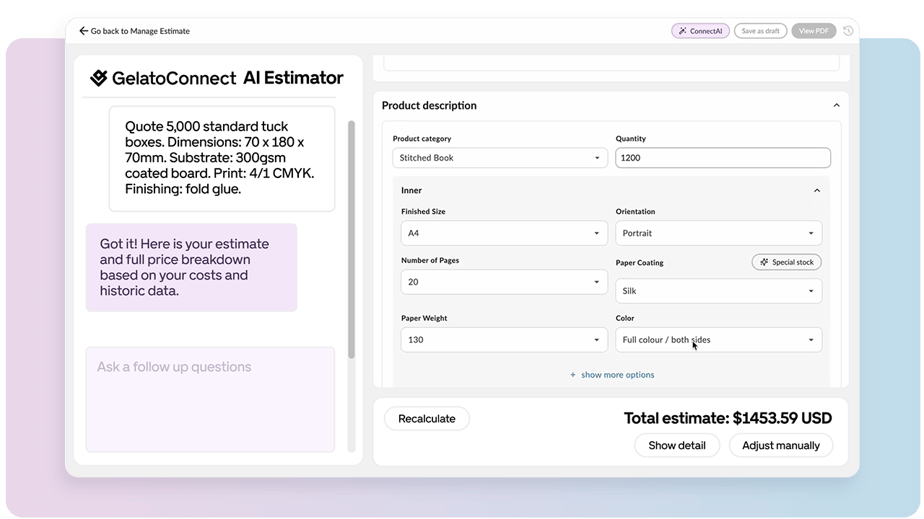
The GelatoConnect Estimator runs over 200 daily estimates at 15 seconds each at ESP Colour, with a 79 percent close rate at Hudson Printing on conversational AI quoting. The senior estimator is no longer the bottleneck on quote turnaround. The role redirects to high-value account growth: complex bid management, RFP strategy, exception pricing, and customer relationship development.
The senior estimator role transformation is not a demotion. It is a redeployment of the most experienced commercial mind in the shop from queue clearance to margin engineering. The same person, with the same domain expertise, applied to the work where domain expertise compounds margin rather than just unblocks the queue. ESP Colour's 95 percent quoting time reduction freed exactly this capacity, and the shop doubled its profit margin and lifted EBIT by 7 percent on the back of that redeployment.
2. Shop floor planner becomes constraint engineer
The scheduling agent resequences the press queue based on the moving constraint, the procurement outlook, and the carrier ETA. The planner role transforms from "build the weekly schedule" to "engineer the constraints the agents optimize against." The constraint engineer designs the routing rules, defines the priority weights, and tunes the resequencing thresholds.
This is the role that owns the operating logic of the shop. Capacity is not a number on a spreadsheet roster. It is a function of the constraints the agents resolve against, and someone has to own those constraints. Oschatz Visuelle Medien GmbH's 25 percent capacity increase without adding headcount came from this kind of role redesign, not from a hardware upgrade. The presses did not get faster. The constraints got tuned.
3. Procurement clerk becomes supplier-relationship manager
The procurement agent watches stock, demand, and supplier lead times, and triggers replenishment. The procurement clerk role transforms from clerical reorder work to strategic supplier-graph management: negotiating tier pricing, qualifying new suppliers, managing supplier-lead-time signals, and handling the exceptions the agent surfaces.
TidyMerch reduced procurement effort from 2 hours per day to under 1 minute on this transition, and the same team recovered 11 percent of volume that had previously been lost to stockouts. The supplier-relationship manager works on the upstream half of the supplier graph, where pricing leverage and resilience live. That is a higher-leverage activity than placing reorder POs, and it is the work the procurement function should have been doing all along.
4. Dispatch clerk becomes logistics-exception specialist
The logistics agent selects carriers across more than 80 partners, validates addresses, and generates labels. T-Shirt Gang cut shipping costs by up to 40 percent on this architecture. The dispatch clerk role transforms from "create labels and reconcile carrier invoices" to handling the 5 to 10 percent of shipments the platform flags for human judgment: specialty freight, customs disputes, weight-restricted SKUs, and hazmat shipments.
Smaller, higher-leverage role. The exception specialist owns the shipments where carrier selection, regulatory handling, and customer communication require domain judgment, and leaves the volume work to the agent. ESP Colour saw 17 percent carrier cost savings just from the address-validation layer; the exception specialist captures the remaining margin upside that automation alone cannot.
5. The owner stops running the week and starts running the year
With the routine on the platform, the owner stops being the chief firefighter and starts being the chief strategist. The week runs from a real-time KPI dashboard the operations team manages by exception. The year-on-year planning, capacity expansion, vertical entry, and acquisition decisions are where the owner's attention now sits.
Bennett Graphics replaced quarterly retrospectives with a real-time KPI dashboard for exactly this reason. When the floor data is current, the owner stops looking backward through quarterly reports and starts looking forward through capacity scenarios, vertical opportunities, and pipeline shape. That is the highest-leverage time the owner has, and it was previously spent solving today's bottleneck.
Three new roles that emerge on the autonomous PSP team
The AI operations lead
Owns the configuration of the AI powered GelatoConnect Estimator 300+ parameters, the routing layer, the procurement agent's reorder thresholds, and the constraint weights on the scheduling agent. Often a senior estimator or planner who moves into this role. Not a software engineer. A domain expert who knows how the shop runs and how to teach the platform to run it. The AI operations lead makes sure the autonomous layer reflects the actual commercial and operating reality of the shop, and tunes it as the shop and its customer mix evolve.
The data-spine owner
Owns the unified data model: SKU master, supplier graph, customer record, and job ticket. Ensures every layer reads from and writes to the same record, with drill-down to source. Often a senior CSR or operations analyst who moves into this role. Smaller team than a traditional IT function. Higher leverage, because the data spine is the foundation the entire autonomous PSP runs on. When the spine is clean, every agent and every dashboard works as designed; when it is not, the autonomous layer cannot operate.
The customer-experience designer
Designs the public-website experience, the conversational AI quoting flow, and the customer-onboarding sequence. Hudson Printing's conversational AI quoting on its public website was designed by someone who held this role, even if the title was something else. As more PSPs run public-website quoting at the GelatoConnect smart quoting's 79 percent close rate and under-1-week sales cycle, this becomes a named role on the team rather than a project handed off between marketing and operations.
The 90-day team-restructuring rollout
- Days 1 to 15: Map current roles to actual activities. List every role and the percentage of time spent on routine activities the platform now handles. The mismatch is the role-design problem.
- Days 16 to 45: Identify the strategic-account-manager candidates, the constraint-engineer candidates, the AI-operations-lead candidates, and the supplier-relationship-manager candidates from the existing team. Almost every shop finds these candidates internally.
- Days 46 to 75: Redesign the org chart around the autonomous-PSP role model. Senior estimators move to account management. Planners move to constraint engineering. Procurement clerks move to supplier relationships. Dispatch clerks move to logistics-exception handling.
- Days 76 to 90: Validate against operating outcomes. The team is the same size. Capacity is up. Revenue per FTE is up. The Oschatz benchmark is 25 percent capacity increase without headcount. The ESP Colour benchmark is 14 FTE redeployed to customer-facing work without headcount loss.
What customers see when the team restructures around the autonomous PSP
When PSPs restructure around the autonomous-PSP role model, the operating outcomes follow a consistent pattern across geographies and verticals.
Oschatz Visuelle Medien GmbH lifted capacity by 25 percent without adding headcount. ESP Colour reduced quoting time by 95 percent, doubled its profit margin, lifted EBIT by 7 percent, and recovered 14 FTE from manual workflow into customer-facing work. Imperial Custom Apparel ran 300 product listings per day with 3 people instead of 17 (a 95 percent productivity gain) and saved over $250K in software costs in the process. Hudson Printing reduced quoting effort by 65 percent and became the first PSP to run conversational AI quoting on its public website, hitting a 79 percent close rate with an under-1-week sales cycle. TidyMerch cut procurement effort from 2 hours per day to under 1 minute, grew 100 percent year over year, lowered warehouse cost per euro of revenue by 35 to 40 percent, and recovered 11 percent of volume previously lost to stockouts. Bennett Graphics took waste from 41 percent to 10 percent, cut packaging and dispatch effort by 80 percent, and replaced quarterly retrospectives with a real-time KPI dashboard the floor manages by exception. T-Shirt Gang cut shipping costs by up to 40 percent on the same logistics architecture.
The pattern is consistent. Same team. Different role design. Higher capacity, higher revenue per FTE, and higher margin.
The structural answer
The print operations team structure 2026 is a design decision, not a downsizing decision. Senior estimators become strategic account managers. Planners become constraint engineers. Procurement and dispatch clerks become exception specialists. New roles emerge: AI operations lead, data-spine owner, customer-experience designer. The owner stops running the week and starts running the year.
PSPs that restructure around the autonomous-PSP role model lift capacity, revenue per FTE, and margin without adding headcount. PSPs that do not are running 2024 job titles against a 2026 operating workload, and the gap shows up as missed dispatch dates, stalled growth, and a senior estimator role transformation that never happened. The shops that make the role-design call deliberately are the ones that compound.
Explore GelatoConnect
- GelatoConnect Workflow: the unified production layer that lets the operations team operate by exception rather than by routine.
- GelatoConnect Control: the leadership dashboard the operations team works from, replacing weekly retrospectives.
- GelatoConnect Strategy: the operating-leverage story for owners restructuring the team around the autonomous PSP.
- AI agents in print production: from quoting to autonomous decisions
- The 6 production KPIs every print operations leader should track in 2026
- How to replace a legacy print MIS in 2026: the 90-day migration framework
- Best print production platform for mid-sized manufacturers
- Future of print production: CEO trends (webinar)
- State of intelligent print production report 2026 (webinar)
- See GelatoConnect in action: walk through the platform live with our team.
Frequently asked questions
How does the print operations team restructure in 2026?
Senior estimators become strategic account managers. Shop floor planners become constraint engineers. Procurement clerks become supplier-relationship managers. Dispatch clerks become logistics-exception specialists. The owner stops running the week and starts running the year. Three new roles emerge: AI operations lead, data-spine owner, customer-experience designer.
Why do legacy print job titles not fit the autonomous PSP?
Senior estimator, shop floor planner, dispatch clerk, procurement clerk, and CSR are titles built for an operation where routine workload required human attention all day. When the routine workload moves to a platform that handles estimating, scheduling, replenishment, and label generation autonomously, those titles describe activities the person no longer performs. The right response is restructuring, not redundancy.
What is the senior estimator role transformation?
The AI Estimator runs 200+ daily estimates at 15 seconds each at ESP Colour with a 79% close rate at Hudson Printing on conversational AI quoting. The senior estimator is no longer the bottleneck on quote turnaround. The role redirects to high-value account growth: complex bid management, RFP strategy, exception pricing, and customer relationship development. Same person, same domain expertise, applied where it compounds margin rather than unblocks the queue.
What does a constraint engineer do?
Designs the routing rules, defines the priority weights, and tunes the resequencing thresholds the scheduling agent optimizes against. The role transforms from 'build the weekly schedule' to 'engineer the constraints the agents resolve against.' Oschatz Visuelle Medien GmbH's 25 percent capacity increase without adding headcount came from this kind of role redesign.
What new roles emerge on the autonomous PSP team?
AI operations lead (owns the AI Estimator's 300+ parameters, routing layer, and constraint weights). Data-spine owner (owns the unified data model: SKU master, supplier graph, customer record, job ticket). Customer-experience designer (designs the public-website quoting flow and customer-onboarding sequence). All three are usually filled internally from existing senior team members.
How long does the team-restructuring rollout take?
90 days. Days 1-15 map current roles to actual activities. Days 16-45 identify the strategic-account-manager, constraint-engineer, AI-operations-lead, and supplier-relationship-manager candidates from the existing team. Days 46-75 redesign the org chart around the autonomous-PSP role model. Days 76-90 validate against operating outcomes. The Oschatz benchmark is 25% capacity increase without headcount. The ESP Colour benchmark is 14 FTE redeployed to customer-facing work.
See GelatoConnect Estimator in action
Turn hours of manual quoting into accurate print quotes in seconds. Start your free trial and generate your first AI-powered quote today.
Start your free trial →