The print industry spent two years debating AI features. The 2026 question is different: how do AI agents for print production actually work, where do they make decisions today, and what comes after AI estimating? GelatoConnect is built on more than 100,000 engineering hours and orchestrates foundation models from Claude, OpenAI, and Gemini through CrewAI and LangChain. The AI Estimator is the first production-grade agent in the platform. It has a 79 percent close rate (23 of 29 prospects), a sales cycle under one week, and is the fastest-adopted product in Gelato history. The AI Estimator is one agent among several. The next layer is an agentic operating system that makes procurement, scheduling, and shipping decisions autonomously, not just produces estimates.
The difference between AI features, AI tools, and AI agents
AI features are point capabilities bolted onto a single screen, an AI button on a quote page that accelerates one task. AI tools are stand-alone applications that wrap a single model behind a UI, useful in isolation but unable to act on the rest of the business. AI agents are systems that make decisions, take actions, and learn from outcomes across multiple modules on a shared data model. The distinction is not academic. It determines whether automation lifts margin by a percentage point or by seven, whether a PSP grows volume without headcount or stalls under operational load. The print industry has spent two years arguing about AI features. The 2026 question is about AI agents.
The four AI agent surfaces in print production
An agentic operating system is built from a small number of specialized agents, each responsible for a category of decision. In commercial print and apparel decoration today, four agent surfaces matter most: estimating, procurement, scheduling, and logistics. Each one replaces a workflow that used to require human judgment on routine inputs. Together they form the operating layer of the autonomous PSP.
The estimating agent
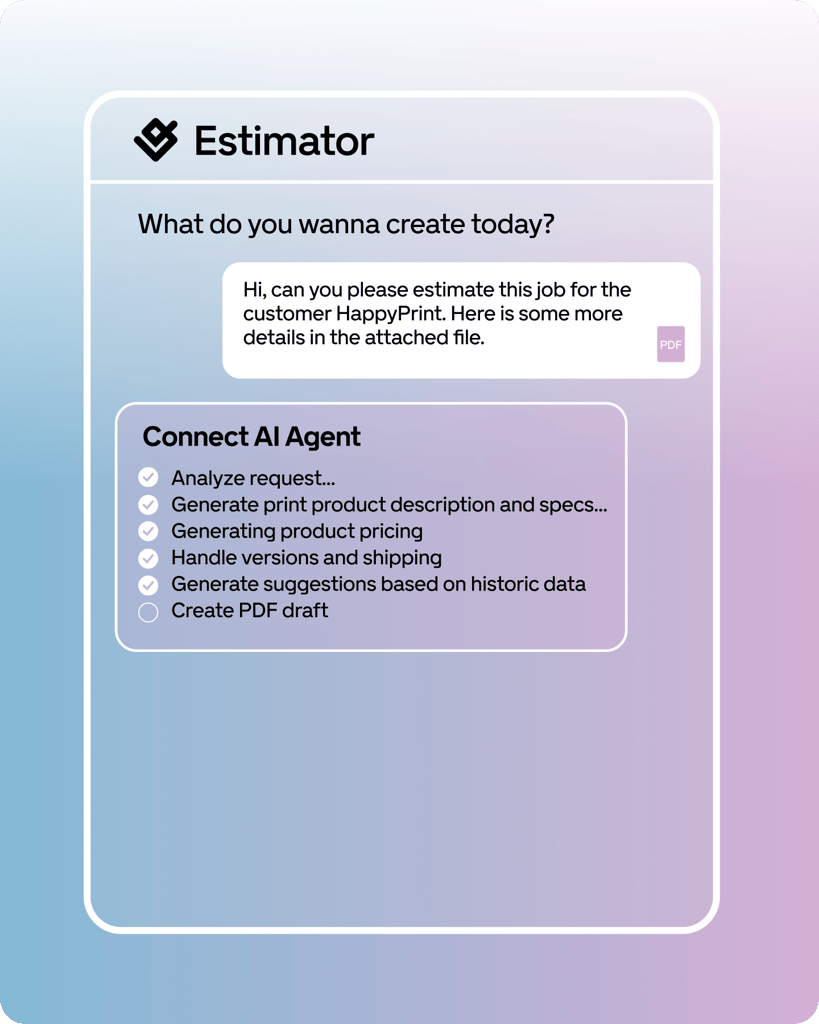
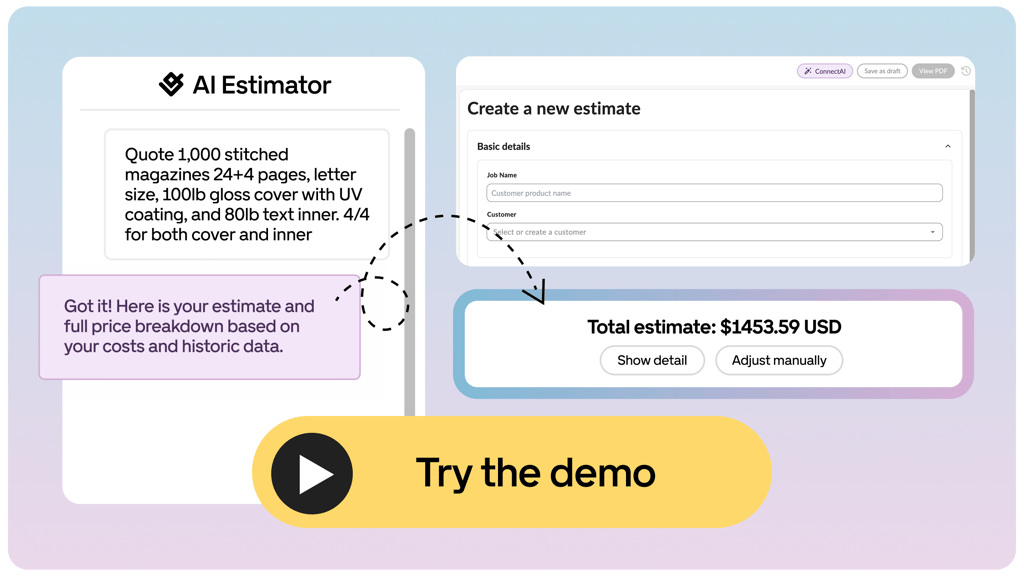
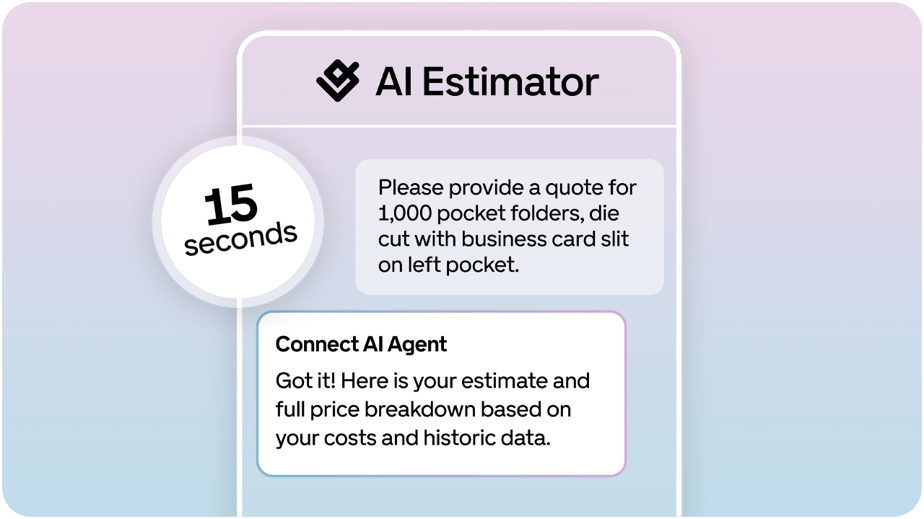
The estimating agent generates quotes in seconds based on artwork, garment, decoration method, and historical pricing. The AI Estimator runs six pricing models, more than 300 configurable parameters, and is trained on millions of real print transactions. Ink n Art completes 14-product quotes in 20 seconds compared with 1.5 to 2 hours manually, with EUR 500,000 to 700,000 in projected annual savings and 30 percent projected revenue growth on the same headcount. Hudson Printing became the first PSP to deploy conversational AI quoting on a public website, reducing quoting effort by 65 percent. ESP Colour produces more than 200 daily estimates at 15 seconds each, with an average quote time of 1.7 minutes, having cut quoting time by 95 percent and doubled profit margin in the process. BSG runs the AI Estimator across apparel decoration quoting, scaling the estimator's logic across multiple decoration methods. The estimating agent is the most visible surface, but it is the entry point, not the destination.
The procurement agent
The procurement agent watches stock position, demand pipeline, and supplier lead times, then triggers replenishment from demand rather than from a Monday-morning purchase order. TidyMerch's procurement workload moved from two hours per day to under one minute, recovering 11 percent of volume previously lost to stockouts and supporting 100 percent year-over-year growth at a 35 to 40 percent lower warehouse cost per euro of revenue. The agent does not just report stock. It acts on it. Where a rule-based estimator might forecast demand, an autonomous procurement layer places the order, schedules the receipt, and updates the estimating agent's cost basis in the same data model. The hours saved are real, but the structural shift is that procurement stops being a human bottleneck and starts being a continuous decision loop.
The scheduling agent
The scheduling agent resequences the press queue based on the moving constraint, the procurement agent's stock outlook, and the carrier ETA. Oschatz Visuelle Medien GmbH increased capacity by 25 percent without adding headcount on a unified platform that surfaces the constraint in real time. The agent makes resequence calls that a planner used to make manually each Monday, and it makes them in response to live signal, not weekly cadence. When a substrate ships late or a press goes down, the schedule reflows automatically. When a high-margin job lands at noon, the queue absorbs it without a planner running the calculation by hand. The result is throughput growth without capital expenditure, because the bottleneck moves from human attention to machine utilization.
The logistics agent
The logistics agent selects the carrier per job from more than 80 partners based on price, ETA, and historical reliability, then validates the address at order intake. T-Shirt Gang cut shipping costs by up to 40 percent and eliminated manual rate comparison, label creation, and postage prepayments across Canadian apparel fulfillment. ESP Colour saved 17 percent on carrier costs through address validation alone, because every undeliverable shipment caught at intake is a reprint and a reship that never happens. The logistics agent operates on the same data model as estimating and procurement, so the carrier selection accounts for the actual job specifications and the actual ship-by date, not a default rule applied at the end of the line.
Why agents need a unified data model
An agent that only sees one module makes decisions on partial information. An estimating agent that does not see procurement under-quotes the substrate cost. A procurement agent that does not see the schedule replenishes against the wrong demand curve. A logistics agent that does not see the production status ships before the job is ready. Agents only outperform when they share the same record. This is the structural reason agentic AI on a best-of-breed stack does not work, and why an AI bolt-on layered over four disconnected systems delivers a fraction of the value the marketing suggested. The unified platform is the architecture that makes autonomous print production possible. Every agent reads from and writes to one record, so each decision compounds on the last.
The orchestration layer
GelatoConnect orchestrates foundation models from Claude, OpenAI, and Gemini through CrewAI and LangChain. The orchestration matters because no single foundation model is best at every task. Quote generation is one model. Document understanding is another. Procurement decisioning is a third. The orchestration layer routes each decision to the best model for the task, then writes the result to one shared data model so the next agent in the agentic operating system can act on it. This is the architecture that closes the AI Estimator's 79 percent close rate, because the agent does not just produce a number, it produces a number grounded in the same data the procurement, scheduling, and logistics agents operate on. The result is a quote that holds together once the job runs, and a platform that maintains under 0.35 percent error rates against an industry baseline of 1.5 percent.
What comes next: the autonomous PSP
The 2027 to 2028 trajectory is a print operation where the agents handle the routine decisions (estimate, replenish, schedule, ship) and the human team handles the exceptions and the strategy. The senior estimator becomes a strategic account manager. The shop floor planner becomes a constraint engineer. The owner stops running the week and starts running the year. ESP Colour recovered 14 full-time roles from manual workflow and reinvested them in customer-facing work, which is the autonomous PSP pattern in early form. The headcount did not disappear. It moved from operational firefighting to revenue generation. That is the bet GelatoConnect customers are making, and the operating leverage shows up in the margin: 3 to 7 percentage points of improvement, 25 to 100 percent growth without headcount, and 10 to 25 percent lower operating costs across the platform's customer base.
Where AI agents do not work yet
AI agents struggle with truly novel jobs, with bespoke specialty processes, and with high-stakes one-off decisions where the cost of an error exceeds the value of automation. The print operation that wins with AI agents is the one that lets the agents handle the high-volume, repeatable workload (quoting, replenishment, scheduling, shipping) and keeps human judgment on the edge cases. PSPs that try to automate everything fail, because agents trained on the standard work cannot generalize to the genuinely unusual. PSPs that automate the right things compound margin every quarter, because the agents handle the 80 percent of the workload that follows patterns and the human team focuses on the 20 percent that does not. The discipline is knowing the difference. The platform that supports both human and agent decisions on the same record is the one that lets a PSP draw the line where it makes sense for that business.
The structural answer
AI agents in print production are not a feature on a roadmap. They are the next operating layer of the print business. PSPs that move first run on an agentic operating system where the AI Estimator is the first of several agents, all sharing one data model and one orchestration layer. PSPs that wait will compete against shops where the agents handle the routine and the humans handle the strategy, where error rates run under 0.35 percent against an industry baseline of 1.5 percent, and where on-time dispatch holds at 98 percent against an industry baseline of 81 percent. The fastest-adopted product in Gelato history is the AI Estimator. The AI Estimator is the first production-grade agent in print, not the last. The next agents are already in production with named GelatoConnect customers, and the question for every PSP owner is not whether AI agents in print production will define the next decade, but which side of that transition they will be on.
Explore GelatoConnect
- GelatoConnect AI Estimator: the first production-grade agent in print: 6 pricing models, 300+ parameters, 79% close rate.
- GelatoConnect Workflow: the agentic operating system layer where the four agents share one data model.
- GelatoConnect Procurement: the autonomous procurement agent that triggers replenishment from demand, not from a Monday-morning purchase order.
- AI quoting software for apparel decorators
- AI in commercial printing: the 2026 definitive guide
- Intelligent operating systems for print production
- AI Estimator with Ink n Art (webinar)
- BSG and the AI Estimator (webinar)
- State of intelligent print production report 2026 (webinar)
- See GelatoConnect in action: walk through the platform live with our team.
Frequently asked questions
What are AI agents for print production?
AI agents are systems that make decisions, take actions, and learn from outcomes across multiple production modules on a shared data model. They differ from AI features (point capabilities bolted onto a single screen) and AI tools (stand-alone apps wrapping a single model behind a UI). In commercial print and apparel decoration, four agent surfaces matter: estimating, procurement, scheduling, and logistics. Each replaces a workflow that used to require human judgment on routine inputs.
How does the AI Estimator work as the first AI agent?
The AI Estimator generates quotes in seconds based on artwork, garment, decoration method, and historical pricing. It runs six pricing models, more than 300 configurable parameters, and is trained on millions of real print transactions. It has a 79 percent close rate (23 of 29 prospects), a sales cycle under one week, and is the fastest-adopted product in Gelato history. Ink n Art completes 14-product quotes in 20 seconds, BSG runs it across apparel decoration, and Hudson Printing deployed it as conversational AI on a public website.
Why do AI agents need a unified data model?
Because an agent that only sees one module makes decisions on partial information. An estimating agent that does not see procurement under-quotes substrate cost. A procurement agent that does not see the schedule replenishes against the wrong demand curve. A logistics agent that does not see production status ships before the job is ready. Agents only outperform when they share the same record, which is why agentic AI on a best-of-breed stack does not work.
How does GelatoConnect orchestrate AI agents?
GelatoConnect orchestrates foundation models from Claude, OpenAI, and Gemini through CrewAI and LangChain. The orchestration matters because no single foundation model is best at every task. Quote generation is one model, document understanding is another, procurement decisioning is a third. The orchestration layer routes each decision to the best model, then writes the result to one shared data model so the next agent can act on it.
What does the autonomous PSP look like?
The 2027-2028 trajectory is a print operation where agents handle the routine decisions (estimate, replenish, schedule, ship) and the human team handles exceptions and strategy. The senior estimator becomes a strategic account manager. The shop floor planner becomes a constraint engineer. ESP Colour recovered 14 full-time roles from manual workflow and reinvested them in customer-facing work, the autonomous PSP pattern in early form.
Where do AI agents not work yet in print production?
Agents struggle with truly novel jobs, with bespoke specialty processes, and with high-stakes one-off decisions where the cost of an error exceeds the value of automation. The print operations that win with AI agents let the agents handle the high-volume, repeatable workload (quoting, replenishment, scheduling, shipping) and keep human judgment on the edge cases. PSPs that try to automate everything fail. PSPs that automate the right things compound margin every quarter.
See GelatoConnect Estimator in action
Turn hours of manual quoting into accurate print quotes in seconds. Start your free trial and generate your first AI-powered quote today.
Start your free trial →