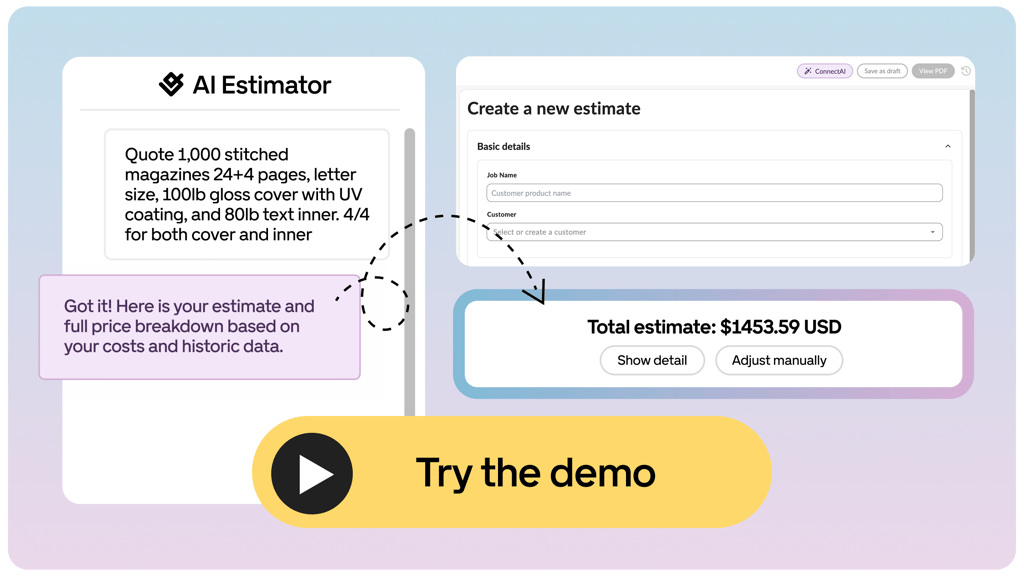
At ESP Colour, a commercial PSP that processes more than 200 estimates every single day, average quoting time has fallen from over 30 minutes to 1.7 minutes. That is a 95 percent reduction. Each of those estimates now takes 15 seconds. Profit margin has doubled, and EBIT has lifted 7 percent. None of this is a pilot or a forecast. It is production data. And it is the clearest proof yet that AI in printing industry workflows has stopped being a future technology and started generating measurable profit for printers in 2026.
The question is no longer whether AI belongs in commercial print. The question is how fast a PSP can deploy it across estimating, workflow, procurement, and logistics before the printer down the road does it first.
Why AI in printing industry operations matters now
The economics of commercial print have inverted. Average run lengths have collapsed from roughly 3,000 units to under 30. The typical PSP now processes more orders per week than at any point in the industry's history, with a fraction of the volume per job. Meanwhile, the people cost of running those jobs has moved the other way. 83 percent of PSPs cite rising labor costs as a top concern, and 72 percent report difficulty hiring production staff.
The glue holding most shops together has not kept up either. More than 50 percent of quote requests still flow through spreadsheets. The average PSP operates 4 or more disconnected systems between estimating, production, procurement, and shipping. Every handoff between those systems is a place where margin leaks, errors enter, or a customer waits.
AI is the only realistic way to run more, smaller, and faster jobs without scaling headcount in lockstep. It is not a feature layered on top of existing software. It is system-level intelligence that makes pricing, production, buying, and shipping decisions simultaneously, based on live data.
AI in print estimating
The problem estimating creates
The average quote takes 30 minutes to produce. Between 20 and 50 percent of those quotes never convert. For a mid-sized PSP, that is thousands of hours a year spent generating zero revenue. Worse, slow quotes lose deals outright. By the time a traditional estimate lands in a customer's inbox, a competitor using AI has already responded, answered follow-up questions, and often closed the job.
The AI approach
Modern AI estimating engines are not lookup tools, supplier APIs, or price sheets. They are models trained on millions of real print transactions, running 6 pricing models and 300 plus configurable parameters tied to a facility's own machines, materials, labor rates, and overheads. The system calculates from the ground up, the way a senior estimator would, but in seconds rather than hours. Every quote is repeatable, every assumption is visible, and every parameter is under the operator's control.
What outcomes look like
The GelatoConnect AI Estimator is already delivering those outcomes in production. ESP Colour cut quoting time by 95 percent (from over 30 minutes to an average of 1.7 minutes), now processes 200 plus daily estimates at 15 seconds each, doubled profit margin, and lifted EBIT by 7 percent. Hudson Printing reduced human quoting effort by 65 percent and became the first PSP to put live conversational AI quoting directly on its own website. Ink n Art delivers 14-product quotes in 20 seconds (down from 1.5 to 2 hours manually), with projected annual savings of 500 to 700 thousand euros and a 30 percent revenue growth projection off the back of faster response times.
AI in workflow and production
Smart batching and production paths
Once a quote is accepted, AI decides how the job moves. GelatoConnect Workflow batches similar jobs, selects the right machine based on capacity and substrate, and routes work to minimize changeover and waste. This is the connective tissue between a sales event and a production output, and it happens without human touch in most cases.
Automated onboarding and mockups
AI has also collapsed the time it takes to bring products online. On the GelatoConnect network, one operation onboarded 300,000 products in 4.5 hours. AI mockup generation produces customer-ready previews in under 2 minutes, eliminating the design bottleneck that used to throttle the front end of production.
AI quality checks
Every file, every mockup, and every production ticket is checked against rules the platform enforces automatically. The outcome across the network: error rates below 0.35 percent versus an industry norm closer to 1.5 percent, 98 percent on-time dispatch versus 81 percent, workflows running up to 10 times faster, and as much as 75 percent less paper waste. TidyMerch grew 100 percent year over year on that foundation, without adding machines or staff.
AI in order intake from digital channels
Orders no longer arrive through a single channel. AI-powered intake connects PSPs to Shopify, Etsy, WooCommerce, TikTok Shop, and Amazon, as well as B2B systems including Infigo and Pressero. The AI normalizes the data across every channel, validates it, and routes it straight to production without manual re-keying. Imperial Custom Apparel, a GelatoConnect Apparel customer, now lists 300 products per day with 3 people instead of 17, runs 95 percent faster on listing operations, and has saved more than 250,000 dollars in software costs. That is a headcount line that disappeared and a toolset that consolidated.
AI in procurement and inventory
AI-driven procurement watches real-time stock levels, predicts demand from the order book, and triggers replenishment before a stockout happens. Supplier onboarding, historically a weeks-long process of price sheets and PDFs, is now AI-assisted and measured in days. Across PSPs running GelatoConnect Procurement, the network data shows 20 percent less capital tied up in stock, 85 percent fewer stockouts, and 70 percent fewer stock-related customer complaints. For a PSP running on thin margins in a short-run market, that is working capital and customer retention in the same release.
AI in logistics and shipping
Shipping is where margin gets reclaimed at the final step. GelatoConnect Logistics selects the right carrier for each parcel across 80 plus partners, validates addresses before dispatch to kill rework, and prices every shipment at volume-aggregated rates no individual PSP could negotiate alone. Savings range from 10 to 25 percent per shipment, and reach up to 40 percent for some customers. Across the top-20 cohort on the platform, shipping cost per order has dropped 23 percent, from 5.20 euros to 4.00 euros. T-Shirt Gang reports up to 40 percent lower shipping costs on its own volume. That is not a marginal optimization. It is a structural cost advantage that compounds on every parcel.
The AI data-network moat
There is a strategic reason the numbers above keep widening. AI performance is a function of data volume, data variety, and data recency. A single PSP building its own AI starts with one facility's data and one facility's failure modes. A networked AI platform is trained on millions of jobs across thousands of machines, hundreds of substrates, and dozens of shipping lanes. Every additional PSP on the network improves the pricing, routing, and buying decisions for every other PSP. The GelatoConnect platform is built on more than 100,000 engineering hours and the aggregate data of the network, using foundation models from Claude, OpenAI, and Gemini, orchestrated through CrewAI and LangChain. The gap between in-house AI and network AI widens every month. That is the commercial insight that should shape a CEO's software strategy for the next five years.
Before and after: the AI in commercial printing scorecard
The table below captures how the core operational metrics shift once AI is deployed across the stack. Numbers reflect documented customer outcomes on the GelatoConnect network and published industry benchmarks where applicable.
| Metric | Before AI | After AI | Industry benchmark |
|---|---|---|---|
| Average quote time | 30 plus minutes | 1.7 minutes (ESP Colour) | 30 plus minutes |
| Quotes that never convert | 20 to 50 percent | Recovered through faster response | 20 to 50 percent |
| Production error rate | Around 1.5 percent | Below 0.35 percent | 1.5 percent |
| On-time dispatch | 81 percent | 98 percent | 81 percent |
| Stockouts | Baseline | 85 percent fewer | Not published |
| Shipping cost per order | 5.20 euros | 4.00 euros | Not published |
| Margin trajectory | Compressed | Doubled (ESP Colour); plus 3 to 7 points (platform average) | Flat to declining |
What to do in the next 12 months
Deploying AI across commercial print is not a single project. It is a sequence, and the order matters.
- Start with estimating. It has the fastest payback and the shortest sales cycle of any AI application in print. Across 29 prospects, 23 have signed, a 79 percent close rate, with an average sales cycle of less than one week. It is the fastest-adopted product in Gelato's history. This is not a coincidence. Estimating is where money leaks first and fastest, and AI plugs that leak in days.
- Layer workflow and quality control next. Once quotes are flowing, connect accepted quotes directly to production. This is where error rates, dispatch accuracy, and throughput move together.
- Close the loop with procurement and logistics. The final layer is the one that frees up working capital and takes cost out of every parcel. It compounds on every order.
In 2026, there is no middle ground left. A shop is either inside a networked AI platform, benefiting from every other customer's data, or outside it, competing against one.
Explore GelatoConnect
- GelatoConnect AI Estimator: the fastest-adopted AI application in commercial print, live in days.
- AI in print production: transform production and boost profits: a companion view focused on the production floor.
- See GelatoConnect's AI stack in action: walk through estimating, workflow, procurement, and logistics live.
Frequently asked questions
How is AI actually used in the printing industry in 2026?
AI now spans every operational layer of commercial print: estimating (quotes in 15 seconds with six pricing models and 300 plus parameters), workflow (smart batching and machine-agnostic routing), product onboarding (300,000 products in 4.5 hours), quality control (under 0.35 percent error rate), order intake from Shopify, Etsy, TikTok Shop, Amazon, WooCommerce, Infigo, and Pressero, procurement (real-time replenishment, AI-assisted supplier onboarding), and logistics (AI carrier selection across 80 plus partners, address validation, volume-aggregated pricing).
What is the fastest ROI AI application for a commercial printer?
AI-driven estimating. The AI Estimator is the fastest-adopted product in GelatoConnect's history, with a 79 percent close rate across 29 prospects and an average sales cycle of less than one week. ESP Colour cut quoting time by 95 percent, doubled profit margin, and lifted EBIT by 7 percent. Hudson Printing cut human quoting effort by 65 percent. Ink n Art projects 500 to 700 thousand euros in annual savings and 30 percent revenue growth.
Can a PSP build its own AI for estimating and production in-house?
In principle yes, in practice no. AI performance depends on data volume, variety, and recency, and a single PSP only ever sees its own facility's data. A networked platform is trained on millions of jobs across thousands of machines, hundreds of substrates, and dozens of shipping lanes. Every new customer on the network improves the model for every existing customer. The gap between in-house AI and network AI widens every month.
What outcomes does AI deliver in print workflow and production?
Production error rates below 0.35 percent versus the 1.5 percent industry average, 98 percent on-time dispatch versus 81 percent, workflows up to 10 times faster, and as much as 75 percent less paper waste. TidyMerch grew output 100 percent year over year on this foundation without adding machines or staff.
How does AI affect procurement and inventory for PSPs?
AI watches real-time stock levels, predicts demand from the order book, and triggers replenishment before a stockout happens. On the GelatoConnect network, PSPs tie up 20 percent less capital in stock, experience 85 percent fewer stockouts, and receive 70 percent fewer stock-related customer complaints. Supplier onboarding drops from weeks to days with AI assistance.
How much can AI lower shipping costs for a print shop?
Between 10 and 25 percent per shipment on average, and up to 40 percent for some customers. Across the top-20 cohort on GelatoConnect, shipping cost per order has dropped 23 percent (from 5.20 euros to 4.00 euros). T-Shirt Gang reports up to 40 percent lower shipping costs on its own volume.
What AI foundation models are commercial print platforms using?
GelatoConnect's AI layer is built on more than 100,000 engineering hours and uses foundation models from Claude, OpenAI, and Gemini, orchestrated through CrewAI and LangChain. The estimator alone runs six pricing models and 300 plus configurable parameters trained on millions of real print transactions across the network.