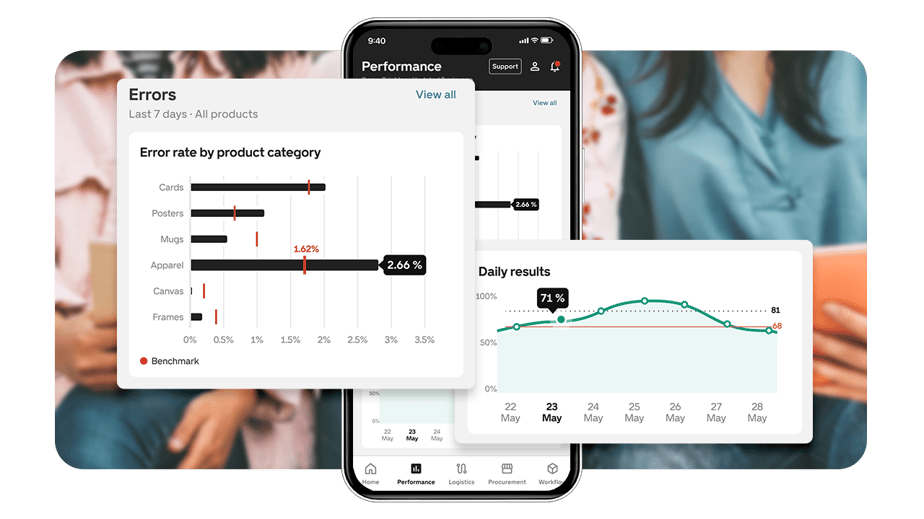
The print industry's accepted error rate is 1.5 percent. GelatoConnect customers run at under 0.35 percent. The gap is roughly 3 to 7 percentage points of operating margin and it compounds quarterly. This guide walks through where print production errors actually originate, how connected job tracking removes them at each stage, the 6 KPIs to monitor, and the Bennett Graphics case where production waste dropped from 41 percent to 10 percent.
Key statistics: the operating gap between disconnected and connected job tracking
- Under 0.35% error rate on GelatoConnect Job Tracking versus a 1.5% industry baseline.
- 98% on-time dispatch versus the 81% industry average.
- Bennett Graphics: 41% to 10% waste reduction; packaging and dispatch effort cut 80%.
- 17% carrier-cost savings at ESP Colour from automated address validation alone.
- 3 to 7 percentage points margin improvement reported by PSPs that consolidate quoting, workflow, procurement, and dispatch on one connected data spine.
Source: GelatoConnect aggregate customer data, 2025-2026.
Where print production errors actually originate
An error rate of 1.5 percent feels small in isolation. On a mid-sized PSP shipping 80,000 orders a year, it is 1,200 errors. Each one carries a rework cost, a margin write-down, a goodwill impact, and a logistics consequence. The compounding number is the real damage: a 1.5 percent baseline at 25 percent year-over-year volume growth means the absolute error count grows faster than capacity to absorb it.
The mistake most operations make is treating errors as a quality-control problem. They are an information problem. Errors originate at five points in the production flow, and disconnected systems hide them at each one:
- Intake. A malformed spec, a wrong substrate, a missing finishing instruction enters the system. A traditional MIS accepts it because intake validation is shallow.
- Estimating to job ticket. The estimate is converted to a job ticket by hand. Spec drift creeps in. The press runs the wrong stock.
- Scheduling. The job is placed on a machine that cannot hold the tolerance the spec requires. First-pass yield fails.
- Production. The operator does not see the spec in context. A color drift, a stock change, a finishing variation is missed because the QC sheet is paper and the dashboard is in a different room.
- Dispatch. The shipping label is generated from stale data. The package goes to the wrong address, the wrong carrier, or the wrong service tier.
Each of these is a separate handoff between separate tools in a typical print operation. Connected job tracking eliminates the handoffs.
How GelatoConnect Job Tracking removes errors at each stage
Job Tracking is the production layer of the GelatoConnect platform. It sees the job from order intake to dispatch on one data spine. Here is how it removes errors at each of the seven stages.
- Validate the order spec at intake. Job Tracking validates artwork, substrate, finishing, and quantity against current capacity and live material availability before the order is accepted. Malformed specs are rejected at intake, where rework is cheapest.
- Lock the quote to a production-ready job ticket. The accepted quote becomes a production-ready job ticket without re-keying. Spec drift between sales, estimating, and the shop floor is eliminated because there is one job record, not three.
- Schedule against real capacity, not nominal capacity. Job Tracking places the job on the optimal machine for the substrate and ganging-eligible neighbors. Avoids the over-scheduling that creates first-pass yield failures further down the line.
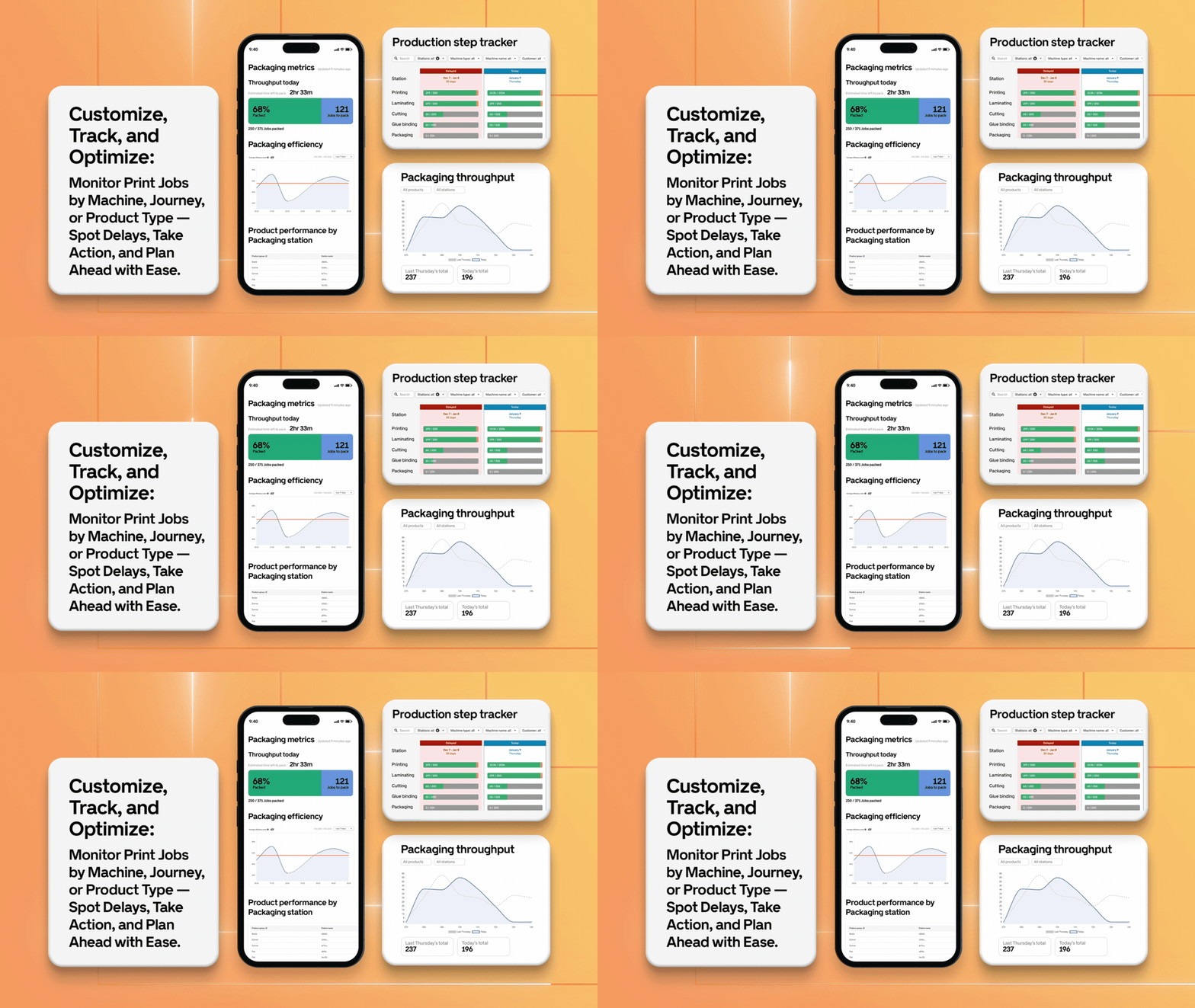
- Surface telemetry inline at the press. The press receives the job ticket directly. The operator sees an AR-style spec overlay. Production telemetry streams back to the platform in real time, so deviation surfaces immediately rather than being discovered at QC two hours later.
- Run layer-aware quality checks. Job Tracking applies layer-aware quality rules inline. Reject patterns are surfaced to the operations dashboard, not buried on a paper QC sheet that nobody reads.
- Validate the shipping label automatically. Best-rate carrier is selected across 80 plus providers per shipment. The label is generated and validated without operator lookup. Address validation alone has delivered 17 percent carrier-cost savings at ESP Colour.
- Feed actuals back into the quote model. Margin-actual vs margin-estimated is written back to the AI Estimator training loop. The next quote on the same job type is more accurate than the last. Errors compound down, not up.
Bennett Graphics: waste 41 percent to 10 percent
Bennett Graphics deployed GelatoConnect with the explicit goal of replacing a paper-driven quality process with a connected job-tracking layer. The outcomes after 12 months:
- Production waste reduced from 41 percent to 10 percent. A 3.7x reduction. The starting point was higher than industry average because the operation ran low-volume, high-variety jobs where every changeover was a rework risk.
- Packaging and dispatch effort cut by 80 percent. Automated label generation and best-rate carrier selection collapsed a multi-step process to one platform action.
- Real-time KPI dashboard replaced quarterly retrospectives. Operations management shifted from reactive to anticipatory. Quality issues that previously surfaced in a quarterly review now surface within minutes.
The compound effect across the year was an operating margin lift that funded the platform within the first two quarters.
The 6 KPIs Job Tracking surfaces on one dashboard
Most PSPs running on a stitched MIS plus point-tool stack track these six metrics in five different systems and reconcile them in Excel. Job Tracking surfaces all six on one dashboard:
- First-pass yield (FPY). Percentage of jobs that meet spec on the first run. The leading indicator of error rate; FPY below 95 percent flags an upstream problem that has not been diagnosed.
- OEE (overall equipment effectiveness). Availability times performance times quality, expressed as one number. The single best signal that scheduling is matching real capacity.
- Scrap rate by SKU. Surfaces the specific job profiles where waste concentrates. Used to refine quoting tolerances and material allocation.
- On-time dispatch percentage. Industry average is 81 percent. Connected platforms run at 98 percent. The 17-point gap is the customer-experience proxy that drives reorder rate.
- Shipping-label accuracy. Address validation failure rate. A leading indicator of carrier-cost leakage and customer complaints.
- Rework hours. The hours spent re-running, re-finishing, or re-shipping a job. Tracks back to the originating stage so the upstream cause can be fixed.
None of these are new metrics. What is new is having all six on one screen with one source of truth, refreshing in real time, and tied back to the originating job record. That is the operating capability that turns a 1.5 percent error rate into a 0.35 percent error rate.
What to do next
If your operation runs at the 1.5 percent industry baseline, the gap to a sub-0.35 percent rate is a one-quarter operating improvement, not a multi-year transformation. Three actions, in order:
- Measure your current first-pass yield and scrap rate by SKU for the last 90 days. If you cannot produce both numbers without an Excel reconciliation, your information layer is the bottleneck.
- Map the five handoff points from intake to dispatch. Score each one as connected or disconnected. Disconnected handoffs are where errors live.
- Run a 14-day trial of GelatoConnect Job Tracking on one production line. The 14-day mark is enough to see the FPY delta and the dispatch-time impact on real volume.
For the full evaluation framework, the 8-question scorecard, and the 90-day migration plan, download the 2026 print MIS buyer's guide. To see the broader connected-workflow argument, read reducing print errors with connected workflow software and the best print production software for 2026.
See the FPY delta on your operation. Book a 30-minute walkthrough of GelatoConnect Job Tracking on your live job profile.