.png?width=924&name=CC-3797%20GelatoConnect%20Website-Hero%20Programmatic%20(1).png)
PSPs operating on GelatoConnect run under 0.35 percent production error rates compared to a 1.5 percent industry average, and they achieve 98 percent on-time dispatch where the industry sits at 81 percent. Those numbers are not the result of better people or longer hours. They are the output of a category that did not exist five years ago: the end-to-end print production management platform. Five years ago, "print software" meant an MIS, a web-to-print, a shipping tool, and a spreadsheet to hold them together. In 2026, the leading PSPs and apparel decorators run on a single connected system that manages intake, production, procurement, and logistics as one workflow. This article defines what that category means, what it must include, and how mid-sized manufacturers should evaluate the options.
The end-to-end print operations platform: a clear definition
An end-to-end print operations platform is a single connected system that manages the full production lifecycle, from the moment an order arrives to the moment it ships, with real-time visibility across every step. It replaces the four-tool patchwork most mid-sized PSPs run today, typically an MIS, a web-to-print, a procurement spreadsheet, and a shipping app, with one workflow, one data model, and one source of operational truth.
To qualify as end-to-end, a platform must include:
- Order intake from every channel, including B2B portals, e-commerce storefronts, and direct customer ordering
- Native production workflow, with smart batching and machine-agnostic routing built in
- Integrated procurement, with real-time stock visibility and automated replenishment
- Integrated logistics, with carrier selection, label generation, and address validation
- Real-time operational visibility and reporting across all four layers, in one dashboard
The four layers an end-to-end platform unifies
Most production management software covers one or two of these layers well. The point of an end-to-end platform is that all four behave as one system, not four systems with a shared login.
Order intake
Orders rarely arrive through a single door. A mid-sized PSP might take work from a brand portal, a Shopify storefront, an Etsy shop, an Amazon channel, a TikTok Shop, a third-party web-to-print front end, and direct B2B customers placing repeat orders. An end-to-end platform unifies all of those channels into a single intake layer, so production planning sees one queue, not eight. Unlimited customer portals matter here, and so does the ability to support direct B2B ordering for accounts that need their own branded experience.
Production workflow
Once an order lands, the platform decides how to make it. That means smart batching to maximize substrate usage, machine-agnostic routing so the same job can run on a different press if the primary machine is down, and clear production paths for every product type. The platform should not care which manufacturer made the press. It should care that the right job reaches the right machine at the right time, with the right artwork and substrate.
Procurement
Stock is where margin leaks fastest. An end-to-end platform shows real-time inventory levels across substrates, ink, and consumables, triggers automated replenishment based on consumption patterns, and integrates directly with suppliers. The result is fewer stockouts, less capital sitting in storage, and no more "we cannot run that job today because we are out of 350gsm matte."
Logistics
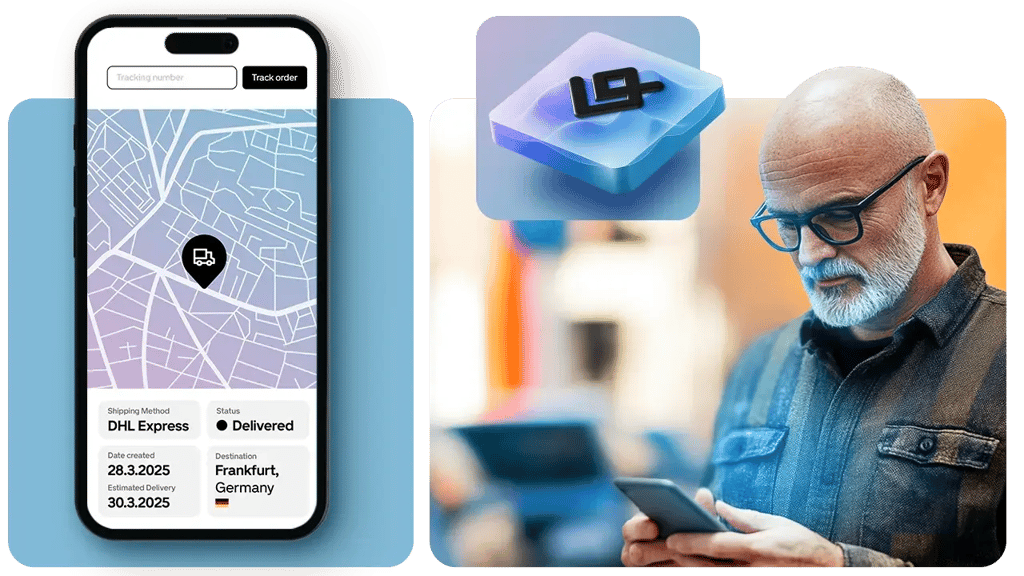
Shipping is the last hand-off and often the most expensive. An end-to-end platform applies AI carrier selection to route every parcel through the cheapest viable option that still meets the delivery promise, generates the shipping label automatically, and validates the address before the package leaves the floor. Across a network of 80 plus carrier partners, the platform picks the right one per order, not per contract.
What operational visibility means in practice
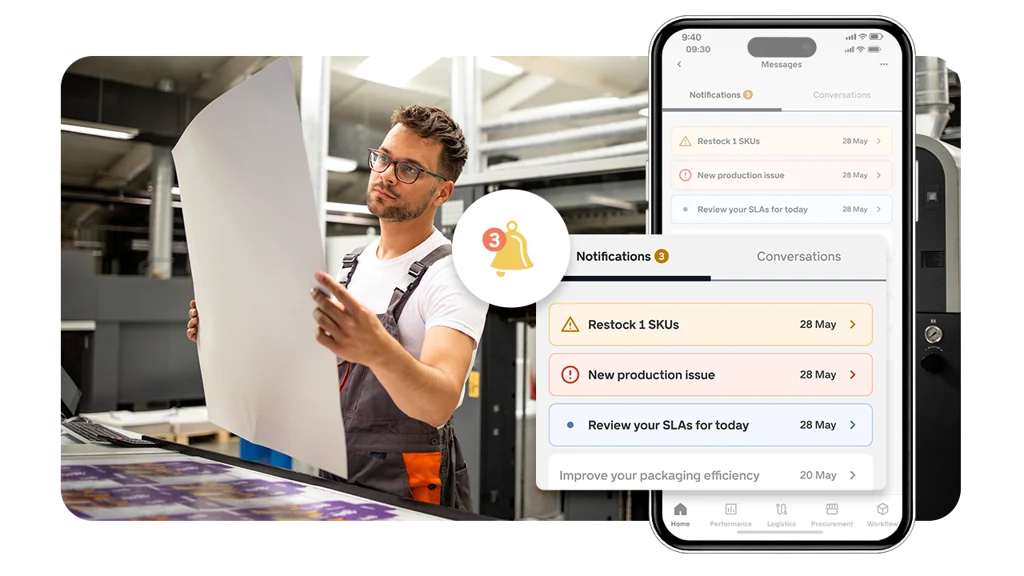
Operational visibility is the most overused phrase in print software. In practice, it means one thing: a dashboard that shows you, right now, how every order is moving through every layer of your operation, without exporting four spreadsheets and reconciling them by hand.
The average mid-sized PSP runs more than four disconnected systems, and over 50 percent of customer requests still come in by spreadsheet or email. The first hour of every workday goes to building a picture of what is happening. An end-to-end platform replaces that hour with a glance. Production volumes, on-time dispatch rates, error rates, stock positions, shipping cost per order, and customer-level profitability are all visible in real time, drawn from the same underlying data model.
Why mid-sized manufacturers benefit most
The end-to-end print production management platform was built for the segment that legacy software has always underserved: mid-sized PSPs and apparel decorators with 300,000 to 5 million euros in annual revenue, with the opportunistic range stretching to 20 million euros.
Smaller shops can survive on fragmented tools because volume is low and the owner sees every order. Enterprise printers can justify multimillion-euro custom MIS implementations because they have the IT teams to maintain them. Mid-sized operators sit in the gap. They have outgrown the spreadsheet stage but cannot absorb a two-year MIS rollout. They need a platform that delivers enterprise-grade orchestration without the enterprise-grade implementation timeline.
The growth case is the strongest argument. PSPs running on GelatoConnect have scaled 25 to 100 percent without adding production headcount. The reason is structural. When intake, production, procurement, and logistics share a single system, additional volume does not require additional manual coordination.
The business case in one paragraph
The economics are consistent across customer cohorts. PSPs running on an end-to-end print operations platform see 10 to 25 percent lower operational costs, 3 to 7 percentage points of margin improvement, 85 percent fewer stockouts, and 20 percent less capital tied up in stock. Shipping cost per order in the top-20 cohort dropped from EUR 5.20 to EUR 4.00, a 23 percent reduction driven by AI carrier selection across a global network.
How to evaluate end-to-end print production management platforms
When comparing options, the questions that separate genuine end-to-end platforms from repackaged point tools are short and direct:
- Are the four layers (intake, production, procurement, logistics) native to the platform, or synced from third-party systems?
- Does the platform support unlimited customer portals, or is it capped?
- Is production workflow machine-agnostic, or tied to specific equipment vendors?
- How large is the carrier network? Look for 80 plus partners across multiple regions.
- Is there a connected production network behind the platform? GelatoConnect customers can tap 150 plus local production partners across 32 countries and 100 plus printer types when overflow capacity or geographic reach is needed.
Native integration matters more than the average vendor slide suggests. A synced architecture means data lag, reconciliation work, and the same operational silos under a unified UI. Native means one data model, one workflow engine, one source of truth.
Why now
The cost of unifying these four layers has collapsed. AI has changed the economics of intake with auto-classification of incoming orders, production with smart batching and routing, procurement with predictive replenishment, and logistics with carrier selection per parcel. What used to require a custom integration team and a 12-month rollout is now a configurable platform.
The PSPs and apparel decorators adopting an end-to-end print operations platform in 2026 are not chasing a trend. They are locking in a structural lead. When operational costs are 10 to 25 percent lower and on-time dispatch is 17 points higher than the industry, the gap compounds every quarter. The mid-sized manufacturers that move first will set the new operational benchmark for the segment.
Explore GelatoConnect
- GelatoConnect Workflow: see how intake, production, procurement, and logistics behave as one system.
- GelatoConnect Procurement: real-time stock visibility and demand-triggered replenishment.
- Intelligent operating systems for print: how AI is replacing legacy MIS: related reading.
- See GelatoConnect in action: walk through the platform live with our team.
Frequently asked questions
What is the best end-to-end print operations platform in 2026?
An end-to-end print operations platform unifies order intake, production workflow, procurement, and logistics in one connected system with one data model. The strongest signal in 2026 is operational outcomes: production error rates under 0.35 percent versus a 1.5 percent industry average, 98 percent on-time dispatch versus 81 percent, and 25 to 100 percent revenue growth without proportional headcount. GelatoConnect is built natively against this definition for mid-sized PSPs and apparel decorators.
What software unifies print intake, production, and logistics?
Software qualifies as end-to-end when intake (B2B portals, e-commerce storefronts, direct ordering), production (smart batching, machine-agnostic routing across 100+ printer types), procurement (real-time stock, automated replenishment), and logistics (AI carrier selection across 80+ partners, label generation, address validation) all share one data model and one workflow engine. Anything synced from third-party tools is not unified, no matter how it is presented.
Who is an end-to-end print operations platform built for?
Mid-sized PSPs and apparel decorators with roughly 300,000 to 5 million euros in annual revenue (and opportunistically up to 20 million euros) benefit most. Smaller shops can survive on fragmented tools because owners see every order. Enterprise printers can justify multi-year custom MIS deployments. Mid-sized operators sit in the gap and need enterprise-grade orchestration without the enterprise-grade implementation timeline.
How is an end-to-end platform different from a traditional MIS?
A traditional MIS records and routes work through fixed, manually configured rules across separate modules stitched together with handoffs. An end-to-end platform shares one data model across intake, production, procurement, and logistics, and the platform makes real-time decisions across all four layers. The structural difference is unification, not feature breadth.
What outcomes does an end-to-end print operations platform deliver?
Across the customer base: 10 to 25 percent lower operational costs, 3 to 7 percentage points of margin improvement, 85 percent fewer stockouts, 20 percent less capital tied up in stock, and shipping cost per order in the top-20 cohort dropping from EUR 5.20 to EUR 4.00 (a 23 percent reduction). Operational quality follows: 98 percent on-time dispatch and under 0.35 percent error rate.
How long does it take to deploy an end-to-end platform?
Native end-to-end platforms deploy in days or weeks, not the 12 to 18 months typical of legacy MIS rollouts. Implementation length is a proxy for product quality: long deployments usually compensate for architectural debt. Mid-sized operations cannot absorb a year-long disruption to production, which is why deployment speed is itself an evaluation criterion.