Most print businesses reach a point where growth stalls not because demand is lacking, but because operations can't keep up. Jobs pile up. Errors multiply. Staff spend more time chasing information than producing output. This is the signature of a manual workflow, and it gets more expensive as volume increases.
Print workflow automation changes this equation. By replacing manual handoffs with intelligent, connected systems, businesses can process more work with the same team, reduce errors systematically, and gain the operational visibility needed to make better decisions.
What manual print workflows actually cost
The costs of manual print workflows are often hidden because they accumulate incrementally. A missed job detail here, a re-run there, a few hours of production downtime waiting for an answer. None of these feel catastrophic individually, but together they represent a significant drag on margin and capacity.
Research across the GelatoConnect network shows that businesses operating on manual workflows typically experience production error rates that are many times higher than those running automated systems. GelatoConnect customers achieve a production error rate below 0.35%. For a business processing thousands of jobs per year, the difference between a 2% error rate and a sub-0.35% error rate represents substantial rework costs, material waste, and customer relationship risk.
The more insidious cost is opportunity cost. When your team is managing manual processes, they are not available to take on additional work. Capacity that could be generating revenue is instead being used to manage complexity that automation could eliminate.
The three layers of print workflow automation
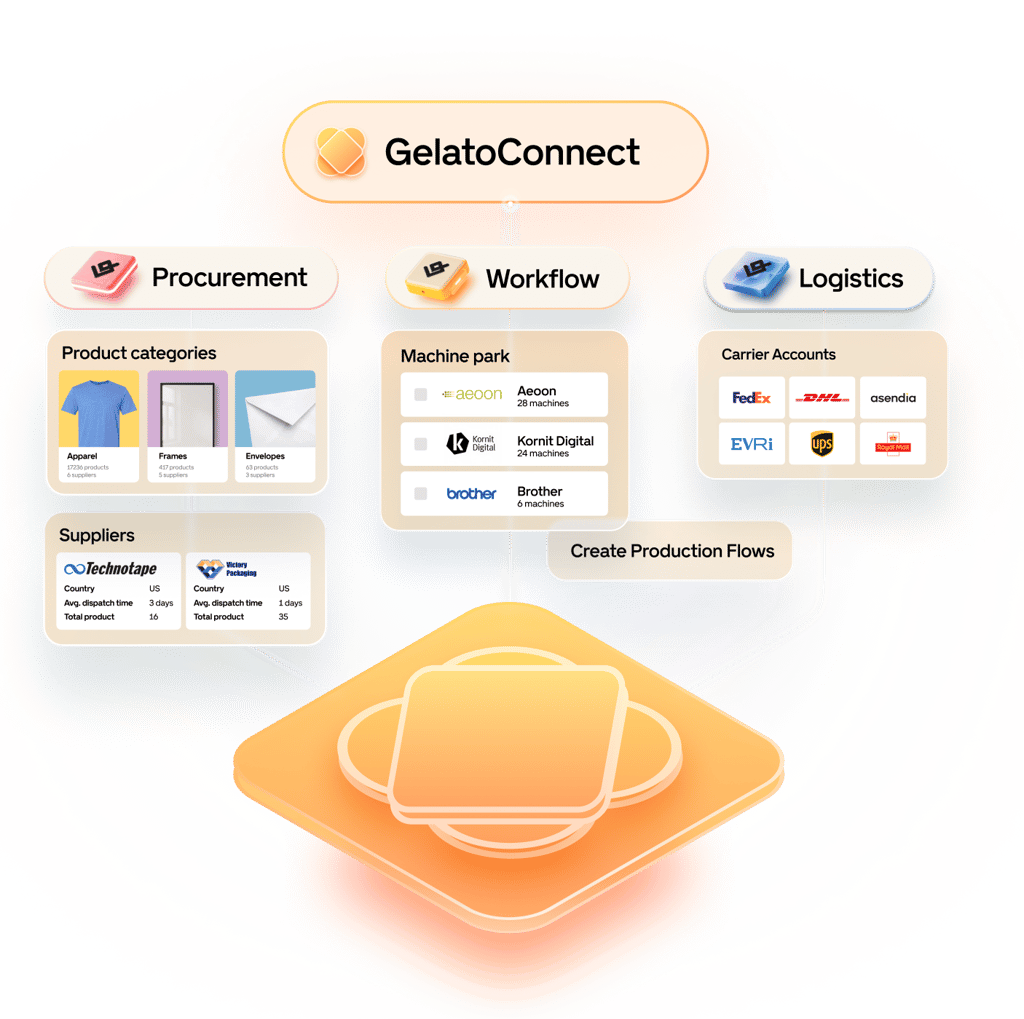
Effective print workflow automation operates across three interconnected layers: procurement, production, and logistics. Automating one layer while leaving the others manual creates bottlenecks that limit the benefits. The most capable platforms integrate all three.
Procurement automation replaces manual supplier management with intelligent purchasing workflows. Rather than relying on purchasing staff to track pricing, manage vendor relationships, and place orders, automated procurement systems monitor inventory levels, track supplier pricing in real time, and trigger purchase orders based on predefined rules. The result is consistent material availability, better pricing through data-driven supplier selection, and a significant reduction in purchasing staff time spent on routine transactions.
Production workflow automation connects order intake, scheduling, job routing, and quality tracking into a single coordinated flow. When a job is accepted, automated systems assign it to the appropriate equipment, schedule it based on current capacity, and route it through each production stage with digital tracking at every step. Errors are caught earlier, jobs move faster, and production managers spend less time firefighting.
Logistics automation extends the workflow beyond the shop floor to delivery. Automated systems select the optimal carrier based on destination, cost, and speed requirements, generate shipping documentation, and provide real-time tracking for both operations teams and end customers. Across the GelatoConnect network, businesses using integrated logistics automation have achieved 10 to 35% reductions in shipping costs.
From reactive to predictive operations
Manual workflows are inherently reactive. Problems are identified after they occur, information gaps create delays, and decisions are made without complete data. Automated print workflows shift operations from reactive to predictive.
When production data flows through a connected system, patterns become visible. Which job types consistently run over time? Which substrates generate the most material waste? Which customers generate the most rework requests? With automated data collection and analysis, these patterns surface automatically rather than requiring someone to manually analyze spreadsheets.
This visibility enables proactive decision-making. Capacity can be planned in advance rather than managed in real time. Supplier relationships can be optimized based on actual performance data. Pricing can be adjusted to reflect true costs rather than estimates. The operational intelligence that automation generates is often as valuable as the efficiency gains from the automation itself.
Implementation: what to expect
The biggest misconception about print workflow automation is that implementation requires a complete operational overhaul. In practice, the most effective approach is incremental: identify the highest-impact bottleneck, automate that first, and build from there. Our guide on building the complete print automation platform walks through how to sequence this investment effectively.
For most print businesses, the highest-impact starting point is either estimating or job scheduling. Estimating automation delivers immediate revenue impact through faster quoting and improved margin accuracy. Scheduling automation delivers immediate capacity impact by reducing the time jobs spend waiting for manual assignment.
GelatoConnect's platform is designed to integrate with existing production infrastructure. It does not require replacing legacy equipment or systems. Instead, it creates a digital layer that connects your existing tools, captures data that was previously lost in manual handoffs, and applies automation logic to routine decisions.
Businesses that have implemented GelatoConnect's integrated workflow automation report operational efficiency improvements of 5 to 30% and dispatch-on-time rates of 98%. Oschatz achieved 20% production growth without adding staff. Bennett Graphics reduced material waste by 75%.
Building the case for automation investment
Automation investment requires a clear return on investment case. The ROI of print workflow automation typically comes from three sources: error reduction, capacity expansion, and cost optimization.
Error reduction is the most straightforward to quantify. Calculate your current rework rate as a percentage of total jobs, multiply by your average rework cost per job, and you have the potential savings from improving accuracy. For businesses with rework rates above 1%, this alone typically justifies the investment.
Capacity expansion is often the larger opportunity. If automation allows your current team to handle 20 to 25% more volume without additional headcount, the revenue potential from that capacity is the primary value driver.
Cost optimization across procurement and logistics adds additional return. GelatoConnect customers have achieved 5 to 20% reductions in raw material costs and 10 to 35% reductions in shipping costs through integrated procurement and logistics automation.
The competitive advantage of intelligent operations
Automation is increasingly table stakes in the print industry. Businesses that have automated their workflows can quote faster, fulfill more accurately, and operate at lower cost per unit. Those still running manual processes face a compounding disadvantage as automated competitors continue to improve.
The transition from manual chaos to intelligent operations is not a single event. It is a series of decisions to replace manual effort with systematic automation wherever the ROI is clear. Each improvement builds on the last, creating operational capability that becomes a durable competitive advantage.
GelatoConnect integrates procurement, workflow, and logistics automation into a single platform built for print production businesses. See how it can transform your operations. Book a demo to explore what intelligent workflow automation looks like for businesses at your scale.