Every capability that a print business needs to compete effectively has a technology component. Estimating accuracy. Procurement efficiency. Production throughput. Logistics cost. Customer service quality. Each of these functions can be improved individually through targeted software investment. But the compounding benefits of automation only fully materialize when these capabilities are integrated into a cohesive platform rather than managed as separate tools.
Building a complete print automation platform is the operational goal that modern print businesses should be working toward. This is not a single purchase decision. It is a strategic journey with clear milestones and measurable returns at each stage. For context on why this matters competitively, see our piece on the future of print and intelligent operations.
Why integrated automation outperforms point solutions
Point solutions, software tools that address a single operational function, produce limited and often temporary improvements. An estimating tool that is not connected to live procurement data will produce more accurate quotes until costs change, then it will drift. A scheduling system that is not connected to real-time production data will optimize in theory but struggle in practice when actual production diverges from plan.
Integration is what transforms individual tools into compounding operational capability. When estimating draws on live procurement data, quotes are automatically accurate. When production scheduling receives real-time job status updates, schedule adjustments are automatic. When logistics selection is informed by production completion data, carrier selection optimizes for both cost and delivery time simultaneously.
The value of each integration is multiplicative rather than additive. Connecting estimating to procurement does not just improve quoting accuracy; it creates the data foundation that pricing optimization requires. Connecting production to logistics does not just improve delivery timing; it creates the performance data that enables systematic carrier management improvement.
The building blocks of a complete print automation platform
A complete print automation platform has five integrated components: AI estimating, procurement intelligence, production workflow management, logistics optimization, and business intelligence analytics.
AI estimating is the revenue-generating foundation. It automates cost calculation across all job types, integrates live material cost data, and improves accuracy through machine learning applied to historical job performance. Print businesses using AI estimators quote faster, win more jobs at accurate margins, and eliminate the pricing variance that creates margin erosion.
Procurement intelligence connects the supply chain to the production lifecycle. It monitors inventory levels against production demand, integrates real-time supplier pricing, and optimizes purchasing decisions to minimize cost while ensuring material availability. GelatoConnect customers have achieved 10 to 30% reductions in stock requirements and 5 to 20% reductions in raw material costs through procurement intelligence.
Production workflow management automates job routing, scheduling, and quality tracking from order receipt to production completion. It provides real-time visibility into production status, identifies bottlenecks before they create significant delays, and maintains the quality monitoring that keeps error rates low. GelatoConnect customers maintain production error rates below 0.35% through systematic workflow management.
Logistics optimization automates carrier selection, generates shipping documentation, and tracks delivery performance. It optimizes across cost, speed, and reliability simultaneously, drawing on performance data from more than 60 logistics partners. GelatoConnect customers achieve dispatch-on-time rates of 98% and have reduced shipping costs by 10 to 35%.
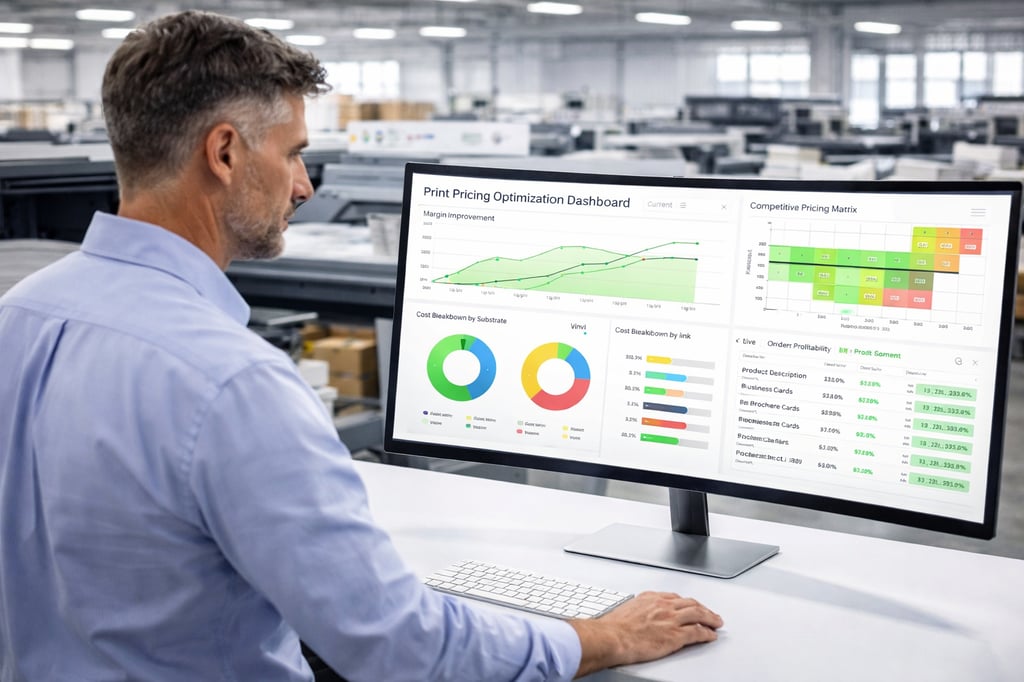
Business intelligence analytics transforms the data generated by all other platform components into operational insight. It connects estimated to actual performance, identifies patterns that indicate process improvement opportunities, and supports data-driven decision-making across every operational function.
Sequencing the build
Few print businesses implement all five platform components simultaneously. The more effective approach is to sequence the build based on where the highest-value opportunity exists and build from there.
For businesses where quoting is the primary bottleneck, AI estimating is the right starting point. The immediate return is measurable in quote volume and margin accuracy. The secondary return is the estimating data that begins building the historical performance dataset that makes other platform components more effective.
For businesses where material cost management is the primary pressure, procurement intelligence delivers the most immediate value. Connecting procurement to real-time supplier pricing and production demand projections typically delivers measurable cost reduction within the first quarter of implementation.
For businesses where production errors or capacity constraints are limiting growth, production workflow management creates the most direct impact. Implementing systematic job tracking and quality monitoring addresses both problems simultaneously, improving both throughput and error rates.
Regardless of the starting point, the platform should be designed with integration in mind from the beginning. Each component should be selected based not just on its standalone capability but on its ability to connect with the other components that will follow.
What a complete platform delivers
The outcomes that become possible with a fully integrated print automation platform are substantially different from what point solutions can achieve. Oschatz grew production capacity by 20% without adding staff. ESP freed up $300,000 in capital through AI-driven procurement intelligence. Bennett Graphics reduced material waste by 75%.
These outcomes reflect what integration makes possible. Faster quoting creates more revenue opportunities. More accurate procurement reduces both cost and working capital requirements. Better production management increases throughput without proportional cost increases. Optimized logistics reduces the cost of delivery while improving reliability.
Across GelatoConnect's platform, businesses consistently achieve 5 to 30% improvements in operational efficiency and 3% improvements in EBIT as the integrated platform compounds across all operational functions. You can review real benchmark data in our ROI report.
GelatoConnect as the foundation
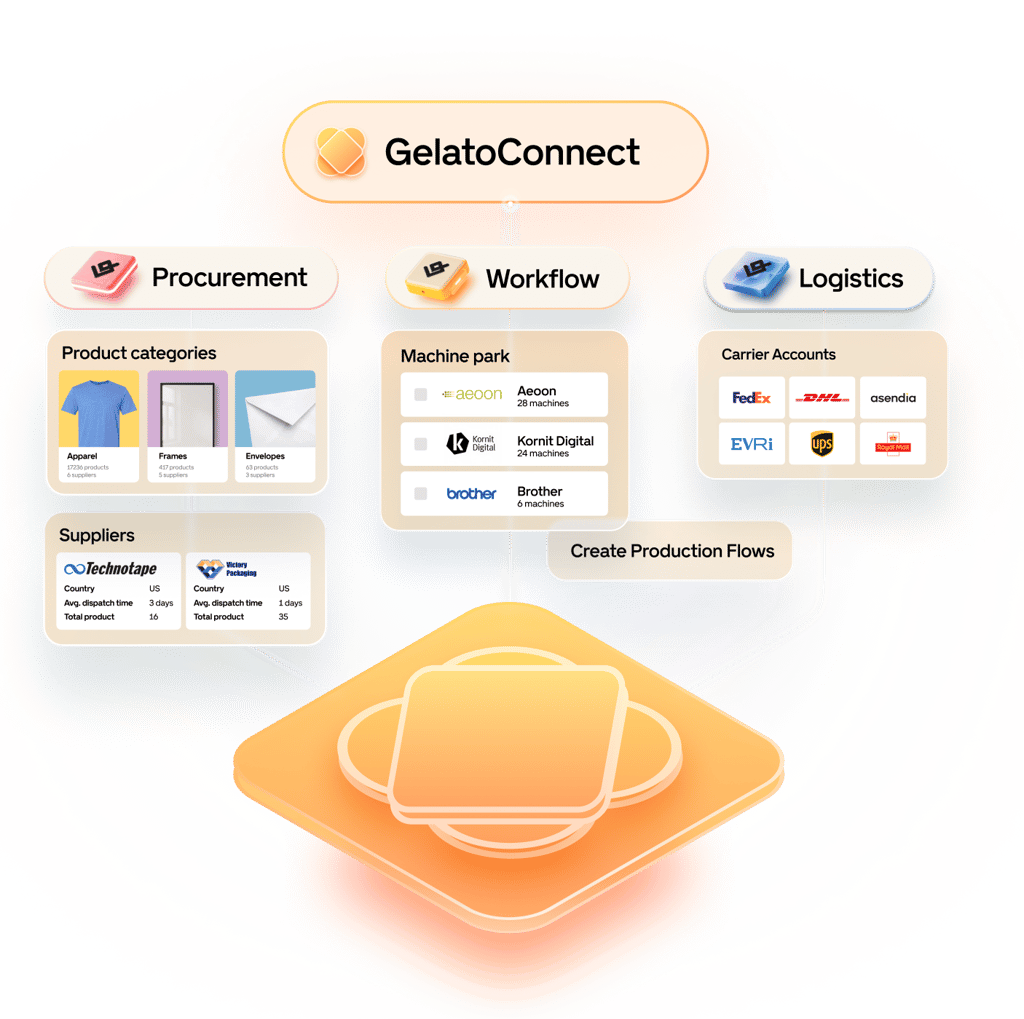
GelatoConnect is designed as a complete print automation platform for businesses generating between $1M and $50M in annual revenue. It integrates programmatic print workflows, procurement, workflow management, and logistics optimization in a single connected system, supported by AI estimating, inventory management, and business intelligence capabilities that draw on the operational data flowing through the platform.
With more than 140 production partners and 60 logistics partners across 32 countries, GelatoConnect brings not just software capability but operational network scale that individual businesses cannot replicate independently.
Book a demo to explore the full platform architecture and understand specifically how each component addresses your operational priorities. Understand how the integration between components creates the compounding value that separate tools cannot deliver.