What software do commercial printers use?
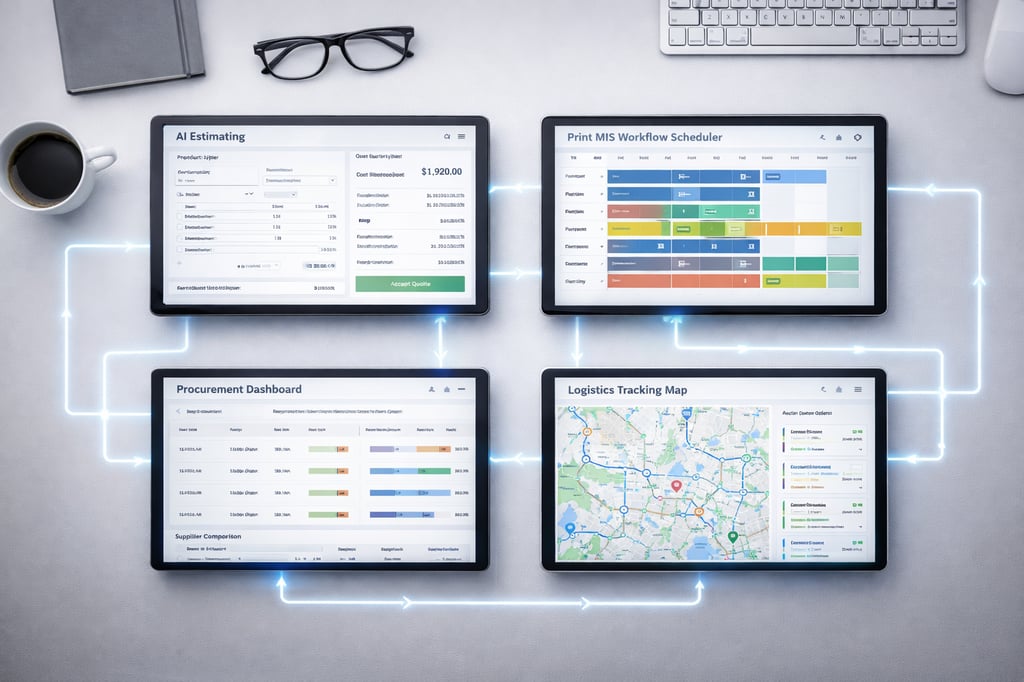
Commercial printers typically use a combination of management information systems (MIS), workflow automation platforms, web-to-print storefronts, prepress tools, and logistics software. The most competitive shops in 2026 are moving away from disconnected point solutions and toward integrated platforms that unify procurement, workflow management, and fulfillment in a single operational system. This consolidation reduces manual data transfer between tools, eliminates integration errors, and provides a complete view of production performance in real time.
Walk through the back office of a successful commercial print shop and you will find a software ecosystem that has grown, often organically, over many years. Each tool was purchased to solve a specific problem. Over time, those tools multiplied into a stack of eight, ten, or twelve systems that require constant manual reconciliation to keep in sync. Understanding what software commercial printers actually use — and why the market is consolidating — is essential context for any print business evaluating its technology today.
The core software categories in commercial printing
Management information systems (MIS). The MIS is the operational backbone. It handles job costing and estimating, customer relationship tracking, order management, and financial reporting. Print MIS platforms have been central to commercial printing for decades. Leading legacy providers include Tharstern, Printware, EFI Pace, and Avanti. The limitation of traditional MIS software is that it excels at recording what happened, but is not designed to manage what is happening in real time across the production floor.
Print workflow automation. Where MIS captures business data, workflow automation handles execution. This layer manages order intake, job routing, prepress validation, automated scheduling, and machine-to-machine handoffs. Modern workflow platforms like GelatoConnect integrate directly with MIS data to eliminate the manual step of moving job information from one system to another. Shops using automated workflow platforms consistently report throughput improvements of 20 to 30% compared to manual scheduling.
Web-to-print storefronts. Customer-facing ordering platforms allow buyers to configure, proof, and place print orders without direct sales team involvement. Web-to-print solutions range from simple product templates to fully configured B2B portals with custom pricing and approval workflows. The value is in reducing order intake labor and enabling 24/7 ordering capability.
Prepress and design tools. Adobe Creative Suite remains the standard for design and file preparation. Enfocus PitStop and Switch are widely used for automated prepress validation and PDF normalization. These tools are increasingly being integrated into automated workflow pipelines, so that file checking happens automatically at order receipt rather than as a separate manual step.
Print procurement software. Sourcing substrates, inks, and specialty materials at scale requires dedicated procurement tooling. Manual procurement processes tie up working capital and introduce pricing volatility. Automated procurement platforms like GelatoConnect Procurement use real-time pricing data and vendor network intelligence to reduce material costs by 5 to 20%. ESP, a GelatoConnect customer, freed up $300,000 in working capital after automating procurement through the platform.
Logistics and fulfillment software. Getting finished product to customers on time requires tight integration between production systems and logistics partners. Standalone shipping platforms like ShipStation handle label generation and carrier selection. More sophisticated operations use platforms with native logistics integrations that automatically generate dispatch instructions and feed tracking data back into the production system.
Why disconnected stacks create compounding problems
The typical commercial print software stack requires an operator to manually transfer data between systems at multiple points in the production cycle: from the web-to-print storefront into the MIS, from the MIS into the workflow system, and from the workflow system into the logistics platform. Each transfer is an opportunity for error. Each system has its own maintenance overhead, update cycles, and user training requirements.
Gartner research on manufacturing technology consistently identifies integration complexity as one of the primary barriers to operational improvement in production environments. When critical data lives in five different systems, the business operates on a fragmented, always-delayed picture of reality.
The shift toward integrated print management platforms
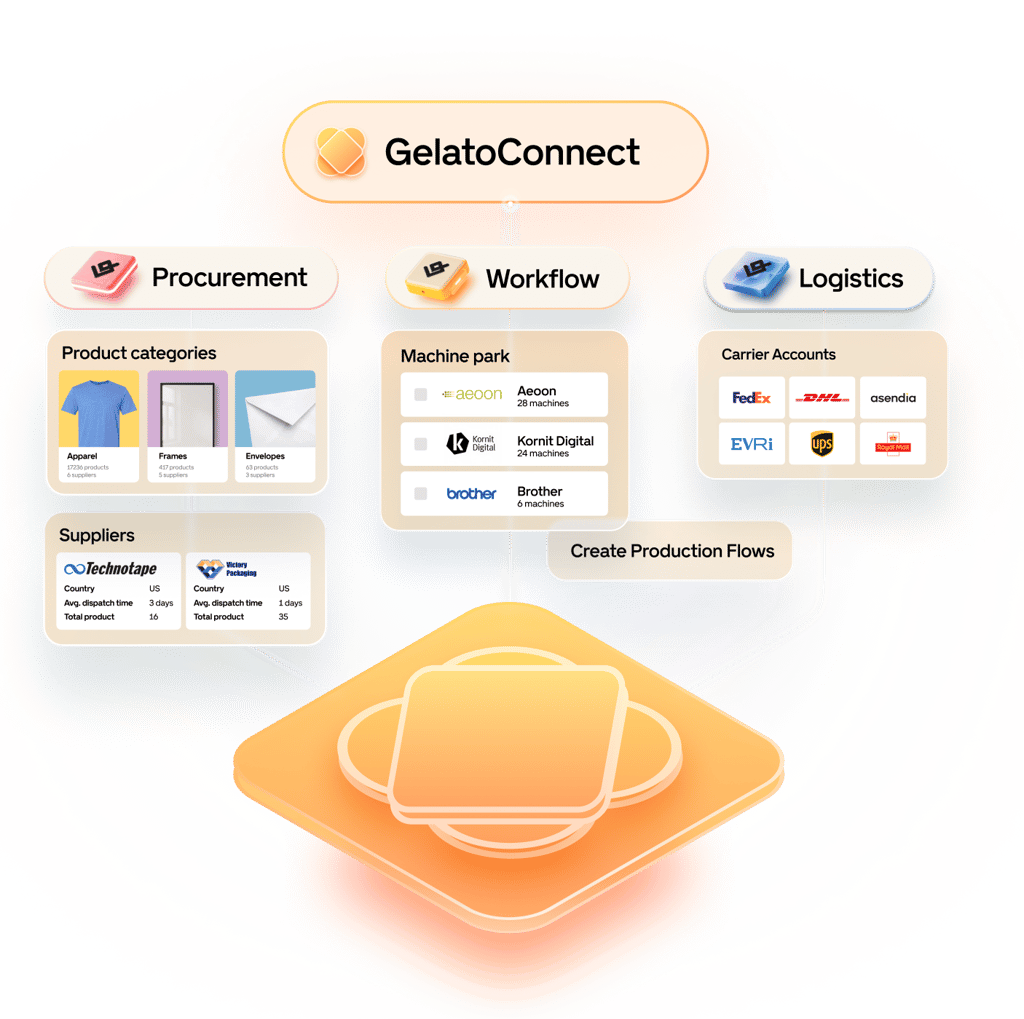
The commercial printing market is consolidating around a different model: integrated platforms that replace the disconnected stack with a single system covering procurement, workflow, and logistics. The operational advantage is straightforward. When order data, procurement data, production data, and logistics data all live in the same platform, there is no transfer step — and no transfer error.
GelatoConnect's platform architecture reflects this direction. It connects procurement, workflow automation, and logistics in a unified operational layer, giving print businesses real-time visibility across the entire production cycle. The platform supports businesses ranging from $1M to $50M in annual revenue, with production partners in 32 countries and more than 60 logistics partner integrations.
Bennett Graphics reduced waste from 41% to 10% after implementing connected workflow management. Exacta cut packaging time by 50%. These results are not primarily about any single feature. They reflect what becomes possible when the entire production lifecycle runs on a connected system rather than a loosely coupled collection of tools.
People also ask
What is the best software for a commercial print shop? The best solution depends on your volume and complexity, but the most effective setups in 2026 combine an MIS with an integrated workflow and logistics platform. Increasingly, businesses are replacing their multi-tool stack with a unified platform that covers all three layers.
Do commercial printers need separate MIS and workflow software? Many did historically, but modern integrated platforms combine MIS-level business management with workflow automation and logistics in a single system. This eliminates data transfer errors and gives operations teams a single source of truth.
How much does print management software cost? Pricing varies significantly by platform and scale. Cloud-based SaaS platforms typically charge monthly subscriptions based on volume or users. Integrated platforms often deliver ROI within the first year through error reduction and efficiency gains that offset subscription costs.
The takeaway
Commercial printers who have assembled disconnected software stacks face a choice: continue managing the integration overhead manually, or consolidate onto a platform designed for the entire production lifecycle. The evidence from the market is clear. The shops operating on integrated systems are dispatching on time at 98% rates, reducing waste by double digits, and scaling revenue without scaling headcount.
The software stack is not just an operational detail. It is the infrastructure your competitive position is built on.
Explore how GelatoConnect unifies procurement, workflow, and logistics for commercial print businesses — see the full platform.
Also explore: GelatoConnect Apparel | GelatoConnect AI Estimator
Related articles: What is print MIS software? | Print workflow automation guide | Print shop management software buyer's guide