What is print shop management software?
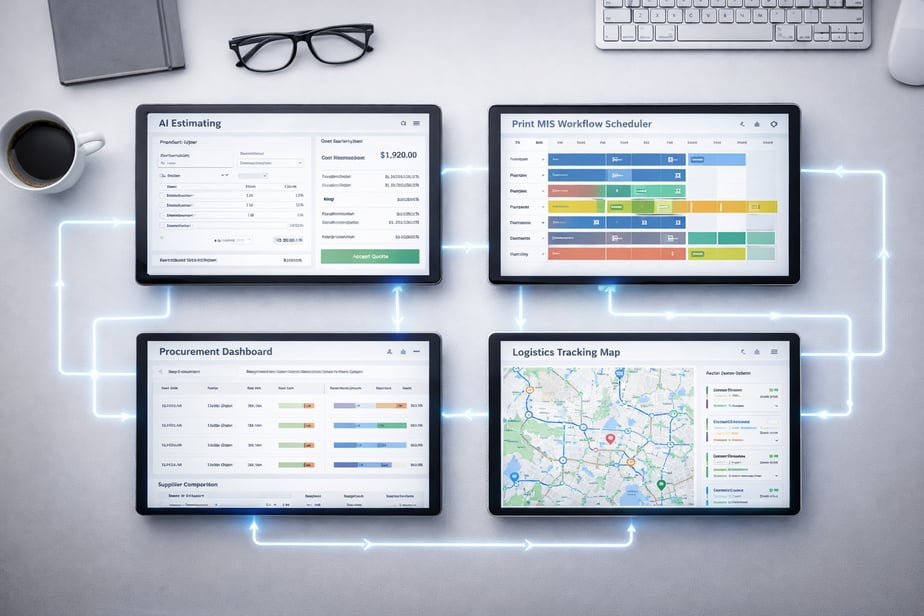
Print shop management software is a platform that coordinates the core operational functions of a print business: estimating, job management, workflow coordination, procurement, scheduling, and reporting. The category spans a wide spectrum, from basic job tracking tools designed for small print-on-demand operations to enterprise-grade integrated platforms that manage multi-site production, complex procurement networks, and third-party logistics fulfillment. In 2026, the most effective solutions combine traditional management functions with real-time workflow automation and supply chain connectivity in a single unified system.
Choosing print shop management software is one of the most consequential technology decisions a print business makes. The right platform becomes operational infrastructure — the system your production, sales, and management teams work inside every day. The wrong one creates friction, data gaps, and integration overhead that accumulates over years.
This buyer's guide breaks down what to evaluate, what to avoid, and how to match platform capabilities to your specific operational needs.
The must-have features in 2026
Job estimating and costing. Accurate estimating is the foundation of profitability. Your management platform must handle multi-variable job costing — substrate, ink coverage, press time, finishing, packaging, and shipping — with configurable pricing logic that reflects your actual cost structure. Look for platforms that support both manual estimates and automated pricing rules for standard products.
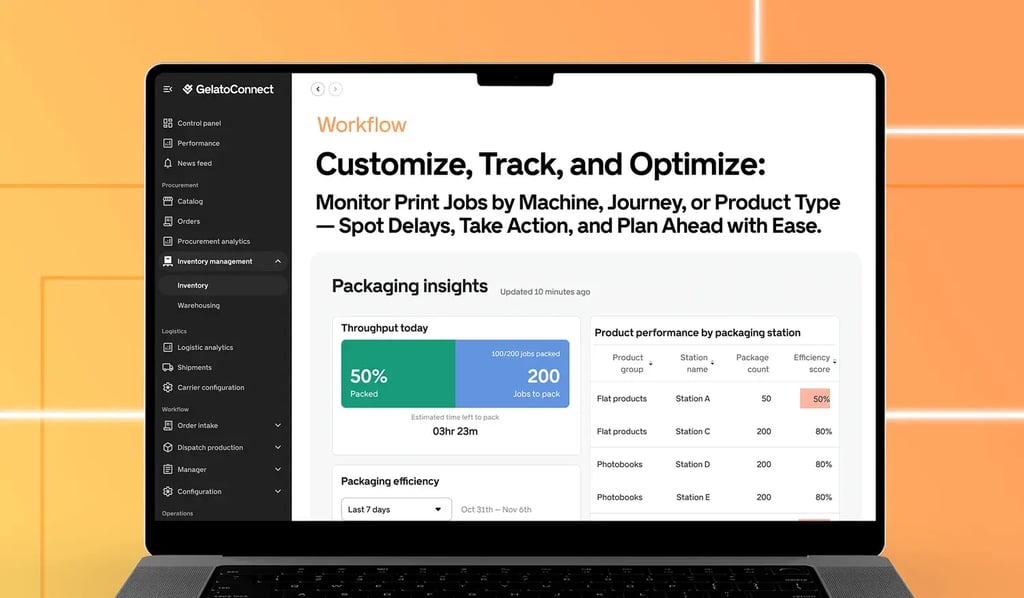
Real-time production tracking. The shift from batch reporting to real-time visibility is the most significant operational improvement in modern print management software. You should be able to see where every job is in the production pipeline at any moment — not at the end of the day, but now. Platforms that still rely on manual status updates or end-of-shift data entry cannot deliver this.
Workflow automation. Job routing, prepress validation, press scheduling, and dispatch triggering should happen automatically based on rules you configure. Manual coordination at each production handoff is the most common source of delays and errors in print operations. Workflow automation eliminates those handoffs.
Procurement integration. If your management platform does not connect to your supplier network, procurement remains a manual, error-prone process running in parallel to your production system. The best platforms integrate procurement directly, so material requirements from the production schedule automatically feed the purchasing workflow.
Logistics connectivity. Finished jobs need to reach customers. Print shop management software that generates dispatch instructions but does not connect to carrier systems requires a manual transfer step that introduces both delay and error. Look for platforms with native carrier integrations and automatic tracking data ingestion.
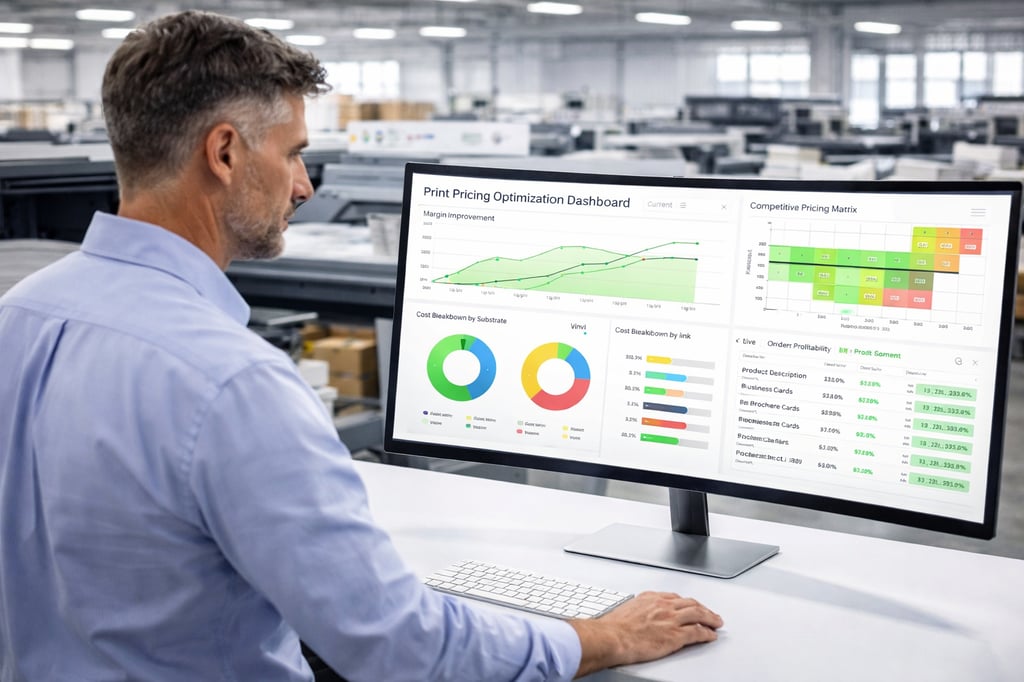
Reporting and analytics. Production data is only valuable if you can act on it. Your management platform should give you job-level profitability analysis, throughput trends, error rates, and on-time delivery metrics — presented in a way that makes operational decisions clear.
Evaluation criteria that matter
Integration scope. The most important question is not which features the platform has but which systems it connects to. Your web-to-print storefront, your ERP or accounting system, your carrier accounts, and your key supplier portals all need to talk to your management platform. Platforms with pre-built integrations reduce implementation time and ongoing maintenance burden significantly.
Configurability vs. out-of-the-box functionality. Every print shop has unique workflow logic. A platform that can only be configured by the vendor's professional services team will lag behind your operational needs. Look for platforms where your team can configure workflow rules, pricing logic, and reporting without requiring a support ticket.
Scalability architecture. A platform that works well for your current volume should also handle 3x or 5x that volume without requiring a platform change. Cloud-based platforms with usage-based scaling are better suited to growth than fixed-capacity on-premise installations.
Migration and onboarding support. Switching management platforms involves data migration, staff training, and a period of parallel operation. Ask specifically about the migration process, how historical data is handled, and what support is provided during the transition period.
Common mistakes in the selection process
Evaluating print shop management software based primarily on feature lists leads to poor outcomes. Two platforms can have identical feature lists and deliver completely different operational experiences based on integration depth, data architecture, and configurability.
Underestimating migration complexity is another common error. The cost of platform change includes not just subscription fees but staff time, productivity impact during transition, and integration development. Factor these into your total cost of ownership analysis.
Selecting for current needs rather than growth trajectory is a mistake that surfaces two to three years after implementation. A platform that is adequate for 100 jobs per day will create real constraints at 300 jobs per day if it was not designed to scale.
How GelatoConnect approaches integrated print management
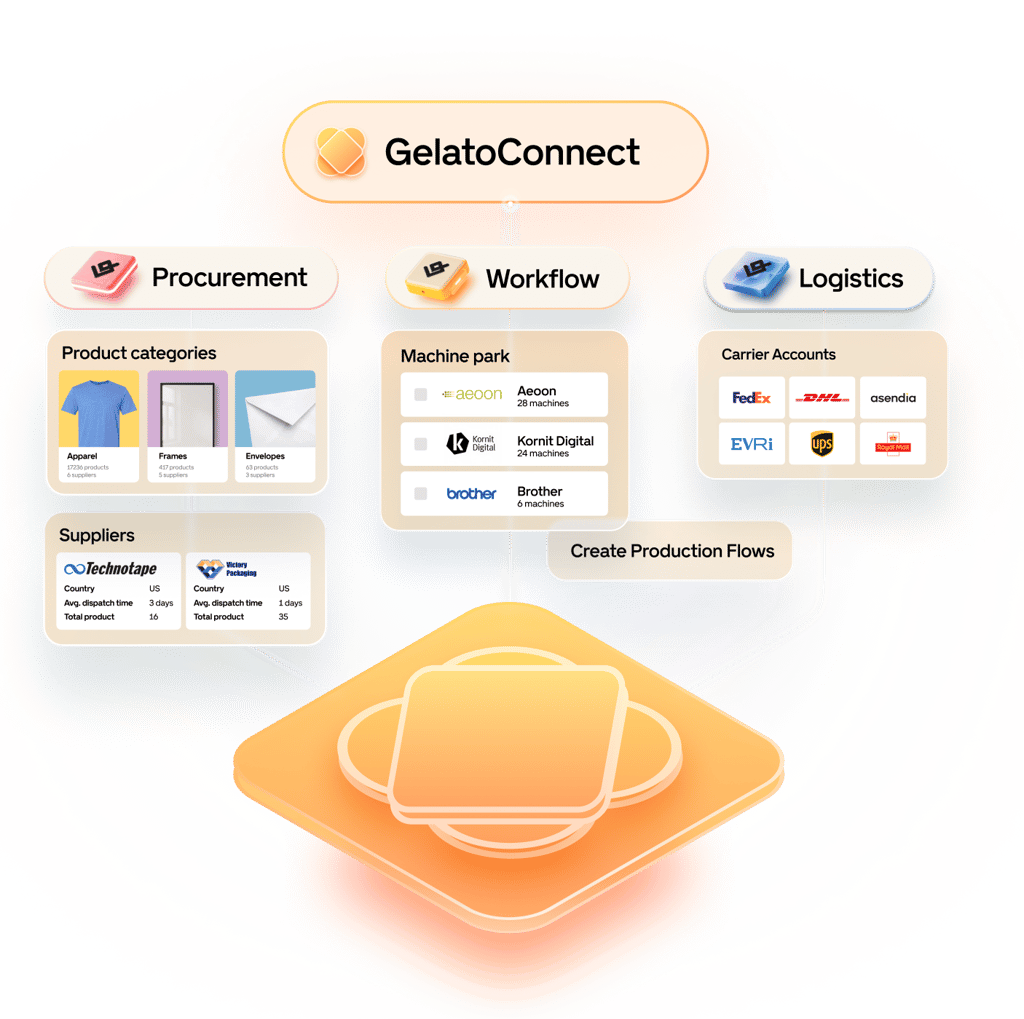
GelatoConnect Programmatic integrates job management, workflow automation, procurement, and logistics in a single platform. Rather than connecting separate best-of-breed tools, the platform delivers a unified operational layer where data flows automatically between functions.
Oschatz achieved 20% revenue growth without adding headcount after implementing connected workflow management. Exacta reduced packaging time by 50%. Bennett Graphics cut waste from 41% to 10%. These outcomes reflect the cumulative operational advantage of a fully integrated platform rather than a collection of well-integrated point solutions.
People also ask
What's the difference between print MIS and print shop management software? The terms are often used interchangeably, though print MIS tends to emphasize financial management (estimating, costing, reporting) while print shop management software increasingly encompasses operational workflow automation. Modern integrated platforms cover both.
How do I compare total cost of ownership for print management platforms? TCO includes subscription or licensing fees, implementation costs (professional services, data migration, integration development), ongoing support costs, and internal IT overhead. Cloud platforms typically have lower TCO over a 3 to 5 year horizon than on-premise alternatives due to lower maintenance and infrastructure costs.
What size print shop needs dedicated management software? Any print shop handling more than 30 to 50 jobs per week benefits from dedicated management software. Below that threshold, generic project management tools may be sufficient. Above it, the coordination overhead of manual management typically exceeds the cost of purpose-built software.
The takeaway
Print shop management software selection is not primarily a feature decision. It is an architecture decision. The platform you choose will determine how your production data flows, how your team coordinates, and how effectively you can scale. Choose based on integration depth, real-time visibility, and scalability — not on feature checklists.
See how GelatoConnect delivers integrated print shop management across workflow, procurement, and logistics — request a demo.
Also explore: GelatoConnect Apparel | GelatoConnect AI Estimator
Related articles: What is print MIS software? | What software do commercial printers use? | Print job scheduling guide