Most PSPs have invested in good tools — MIS, web-to-print, shipping software, prepress systems. But even with great components, things can fall apart if the system isn’t designed to work together.
Episode 4 of Unjammed: The Software Strategy Series for Print Leaders unpacked this challenge. The issue isn’t usually the tools themselves — it’s the gaps between them.
Why PSP Systems Break Down
Dom Hill, SVP of Logistics at GelatoConnect, has worked with dozens of PSPs to untangle overlapping stacks. He describes a familiar pattern:
-
PSPs typically run 4–6 disconnected systems: MIS, prepress, shipping, inventory, storefront, plus spreadsheets.
-
Each tool works in isolation, but they don’t “speak the same language.”
-
Manual work creeps in to bridge the gaps — copy-pasting orders, rekeying data, duplicating tracking info.
Instead of simplifying, the system grows more complex.
The Build vs. Buy Dilemma
One common turning point is whether to build custom integrations or buy new platforms.
Dom’s advice is clear:
-
Building custom middleware sounds appealing, but is rarely worth it. It’s costly, fragile, and hard to maintain. PSPs who go this route often find themselves stuck when something breaks.
-
Buying best-of-breed tools works — but only if integration is prioritized. Without a strong strategy, even the best tools create silos.
Single platform strategies simplify. Modern platforms aren’t as rigid as legacy systems. They combine flexibility with a unified source of truth.
Common Signals of a Broken Stack
In Episode 4, several signals came up repeatedly:
-
Orders copied between systems manually.
-
Shipping labels created outside of core workflow.
-
Tracking data not linked back to MIS.
-
Reporting fragmented across multiple dashboards.
If these feel familiar, you’re not alone. Most PSPs have at least one of these cracks in their setup.
Integration Strategy: The Missing Piece
Dom emphasized that the key isn’t just selecting tools — it’s mapping workflows first.
Integration strategy means:
-
Understanding every step of your order flow.
-
Mapping how data should move — not just how it does today.
-
Choosing tools that can pass information seamlessly.
The goal isn’t “plug and pray.” It’s designing a system that’s greater than the sum of its parts.
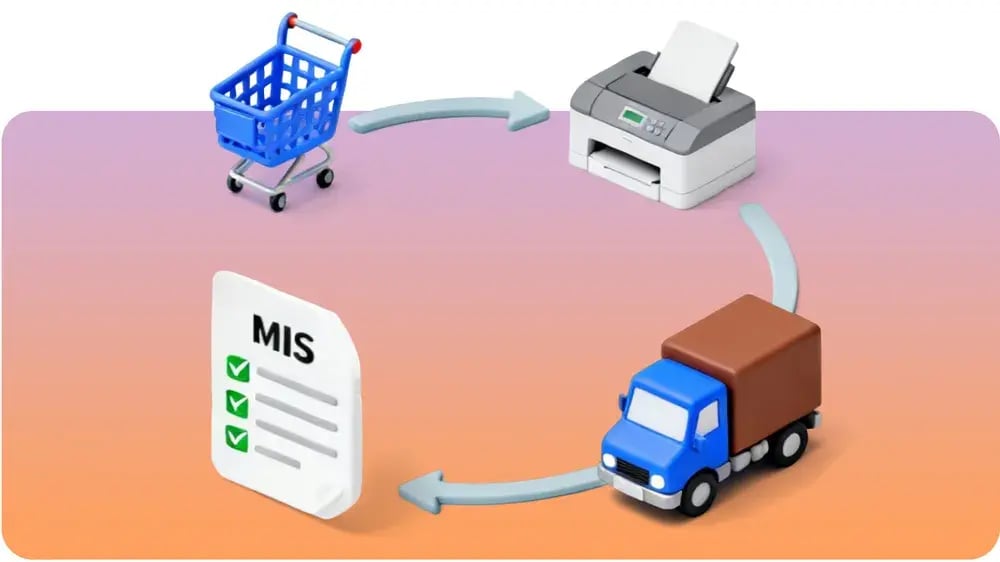
Takeaway: Design the System, Not Just the Tools
The big message from Episode 4: It’s not the tools, it’s the gaps.
PSPs that succeed long term design for integration, not just individual features. Whether you choose best-of-breed, hybrid, or single platform, the goal is the same: one connected flow of data, one source of truth, and less manual work.
Map your current stack, flag cost traps, and plan a smarter architecture with our interactive tool and download below.