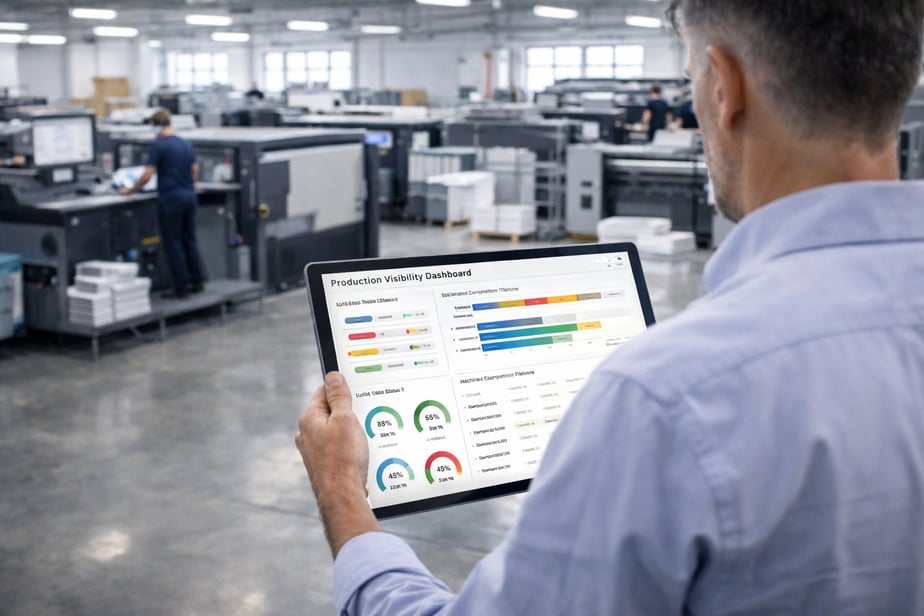
Production management in print is a high-stakes coordination challenge. At any given moment, dozens or hundreds of jobs are in various stages of production, each with its own specifications, deadlines, and resource requirements. The question every production manager asks, continuously, is: what is the status of every job, and what requires my attention right now?
In most print businesses, answering that question requires walking the floor, checking status boards, and making phone calls. It is time-consuming, inherently incomplete, and always slightly behind. Real-time production visibility changes this fundamentally.
Why print production visibility has historically been limited
Print production has always generated data. Machine logs, job tickets, material records, and delivery documentation have existed for decades. The problem is that this data has historically lived in disconnected places, been captured manually, and been processed too slowly to support real-time operational decisions.
When a job's actual production time diverges from its schedule, the impact on downstream jobs takes time to propagate through a manual tracking system. By the time the production manager knows there's a problem, several downstream decisions have already been made on outdated assumptions. The result is reactive firefighting rather than proactive management.
The gap between data generation and data availability for decision-making is where real-time production management creates its primary value. When production data is captured automatically and made available to decision-makers in real time, the response window to emerging issues shrinks from hours to minutes.
What real-time production visibility enables
Real-time print production management provides four capabilities that manual or batch-update systems cannot deliver.
Live job status tracking. Every job's position in the production queue, current production stage, and estimated completion time are visible on a single dashboard without manual updates. When a job falls behind schedule, the system surfaces the variance automatically, along with its impact on downstream jobs and delivery commitments.
Capacity and throughput monitoring. Real-time data on machine utilization, operator productivity, and production queue depth enables managers to identify bottlenecks before they cause significant delays. When one production stage is running at capacity while others are underutilized, the system provides the information needed to rebalance workloads.
Quality and error tracking. Automated quality checkpoints at each production stage capture error rates in real time rather than at end-of-job inspection. When a quality issue emerges at press, the system flags it immediately so corrective action can be taken before the issue compounds across a full production run.
Delivery commitment accuracy. When production status data is connected to customer-facing delivery commitments, the business can proactively communicate with customers about schedule changes. GelatoConnect customers achieve a dispatch-on-time rate of 98%, enabled by integrated production and logistics visibility and shipping management.
The connection between visibility and margin
Real-time production visibility is often positioned as an operational efficiency tool, but its impact on margin is equally significant.
Production errors caught at the source cost a fraction of what they cost when caught at delivery. A press error identified at the quality checkpoint after printing can often be corrected with minimal rework. The same error discovered when a customer receives a defective order involves reshipping, reprinting, and relationship repair. GelatoConnect customers maintain production error rates below 0.35%, a level achievable only through systematic real-time quality monitoring.
Capacity utilization improvements directly affect cost per unit. When real-time data shows that equipment is consistently underutilized during certain shifts or days, that information enables scheduling adjustments that spread fixed costs across more production volume.
Material waste reduction requires real-time feedback between production data and procurement decisions. When waste patterns are visible in real time across job types and substrate combinations, procurement can adjust stock levels and supplier relationships to minimize waste-related costs. Bennett Graphics reduced material waste from 41% to 10% using intelligent production management with real-time visibility.
From visibility to intelligence
Real-time visibility provides the data foundation that operational intelligence requires. When production data flows continuously into an analytical system, patterns emerge that are invisible to manual observation.
Which equipment generates the most maintenance-related delays? Which operators produce the highest quality output on specific job types? Which substrates consistently require more production time than scheduled? These patterns, visible only through systematic data analysis, enable operational improvements that compound over time. For a deeper look at how this data feeds strategic decisions, see our piece on print business intelligence.
Machine learning applied to production data takes this further. Predictive maintenance models can identify equipment failure signatures in operational data before failures occur, enabling preventive maintenance scheduling that minimizes unplanned downtime. Scheduling models can learn from historical performance to produce increasingly accurate time estimates that reduce schedule variance.
Oschatz achieved 20% production growth without additional staff by implementing intelligent production management. The growth came from operational improvements driven by data that was always being generated but had never been systematically analyzed before.
Implementing real-time production management
Transitioning to real-time production management requires connecting production data sources to a unified platform. The most common starting points are automated order intake, job tracking integration with existing MIS systems, machine data capture through production equipment interfaces, and quality checkpoint automation at key production stages.
GelatoConnect's production management module provides the integration infrastructure needed to connect these data sources and the analytical tools to transform the data into actionable operational intelligence. It is designed to work with existing production equipment and management systems, adding a real-time data layer without requiring equipment replacement.
See how real-time production visibility changes the operational experience for print production managers. Book a demo to explore how GelatoConnect Workflow performs against your specific production environment and management challenges.
%203-1.png?width=1024&height=1024&name=Apparel%20(2)%203-1.png)