/GettyImages-1388733856.jpg?width=924&name=GettyImages-1388733856.jpg)
The print market in 2026 rewards speed. Buyers expect a quote in minutes, not days. Margins are compressing as input costs stay high and price transparency spreads. And the workforce is thinner, with skilled estimators and production planners harder to hire every year. In this environment, growth no longer comes from buying another press. It comes from unlocking more revenue from the capacity, customers, and data you already have. You do not have to rip out your MIS. You have to upgrade the growth infrastructure around it. This guide breaks down the 12 growth levers every print service provider can pull in 2026, each with concrete tactics and real results from print shops already pulling them. If you want a tailored view of which levers matter most for your operation, book a growth consultation.
What "growing a printing business" really means in 2026
Growing a printing business in 2026 means increasing revenue and profit without a proportional increase in machines, headcount, or floor space. It is a shift from capacity-led growth to intelligence-led growth.
Concretely, growth now comes from four sources: more revenue per customer (through repeat orders, larger accounts, and self-serve channels), more revenue per production hour (through automation and faster quoting), more sales channels (through e-commerce and web-to-print), and more product categories (through access to fulfillment you do not own). Buying a bigger press only helps if you can quote faster, sell wider, and keep the customers you win. The levers below are ordered so that the fastest, lowest-cost moves come first.
The 12 growth levers every PSP can pull
A growth lever is a specific, repeatable change that increases revenue, margin, or capacity without requiring new capital equipment. These 12 levers span speed, channels, product mix, retention, and cost, and most can run in parallel.
1. Respond to RFQs in seconds, not days
Quoting speed is the single fastest lever a print shop can pull, because the first accurate quote usually wins the job. When your team takes hours or a full day to respond, you lose work to whoever answers first. Speed is not a nice-to-have. It is a competitive weapon.
Tactics: replace manual calculation with an AI quoting engine trained on your own costs, let sales and customer service staff generate quotes without a specialist estimator, and put self-serve quoting on your website so buyers can price their own work. The GelatoConnect Estimator produces estimates in 15 seconds and customer-ready quotes in under five minutes.
- ESP Colour cut average quoting time by 95%, from 30-plus minutes to 1.7 minutes.
- BSG used instant, self-serve quoting to compete for a £750,000 tender and won it by responding first.

2. Add an e-commerce sales channel your customers can self-serve
A self-serve sales channel is a branded online storefront where your best customers order and reorder without waiting for a rep. It turns your quoting and ordering process into a 24/7 revenue channel. Your largest B2B accounts want to place repeat orders at 9pm on a Sunday, not wait for a callback on Monday.
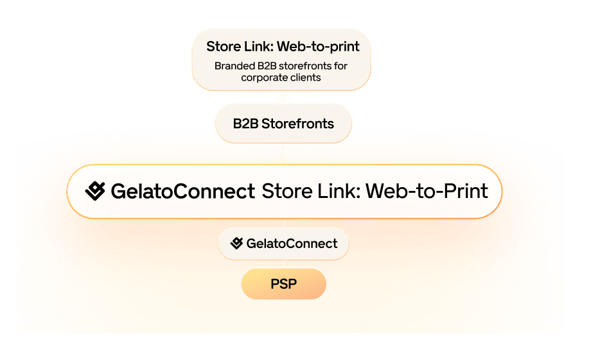
Tactics: stand up a branded portal for your top accounts, enable saved products and one-click reorders, and route storefront orders straight into production. A web-to-print storefront lets customers configure, approve, and reorder on their own schedule.
- Benchmark: leads contacted within one hour are 7x more likely to convert (Harvard Business Review). An always-on storefront removes the wait entirely.
3. Expand your product mix without buying new equipment
Product-mix expansion means selling products you do not currently manufacture by tapping fulfillment capacity you do not own. It grows revenue per customer with zero capital expenditure. When a customer asks for apparel, packaging, or promo and you say no, that revenue walks to a competitor who says yes.
Tactics: identify the adjacent categories your existing customers already buy elsewhere, offer them through a fulfillment network instead of turning them away, and keep the customer relationship on your side of the table. The GelatoConnect production network gives you access to global fulfillment for products outside your current line.
- Framing: every "we don't do that" is a margin leak. Access to distributed capacity converts requests you used to decline into revenue.
4. Unlock production capacity through automation
Capacity unlocking through automation means producing more output with the same team by removing manual steps between order and dispatch. It raises revenue per production hour. Most PSPs are not capacity-constrained by their machines. They are constrained by the manual work surrounding them.
Tactics: automate file prep and job routing, connect procurement and warehouse data to the production floor, and eliminate the copy-paste between disconnected systems. Free the hours your team loses to coordination.
- Oschatz Visuelle Medien grew production output by 20% without adding headcount, after automating workflow, procurement, and logistics.
5. Price with data, not gut
Data-driven pricing means every quote is built from your real costs and margin rules, not one person's memory. It protects margin and frees up cash. When pricing lives in an estimator's head, you carry two risks: inconsistent quotes and cash locked in the wrong places.
Tactics: enforce consistent margin rules across every estimator, connect estimating to your actual cost and inventory data, and use analytics to see win rates and profitability by job type. AI-driven print estimating applies the same logic to every quote, every time.
- ESP Colour reduced the cash tied up in its warehouse by 20%, freeing roughly $300,000 in working capital, alongside 11% year-over-year margin growth.
6. Turn one-time buyers into repeat customers
Retention growth means converting a single order into a recurring relationship, which is far cheaper than acquiring a new buyer. Repeat revenue compounds while acquisition cost stays flat. A print shop that only sells once is running to stand still.
Tactics: offer subscription and recurring-order options, save reorder templates so buyers repeat in one click, automate post-delivery follow-ups, and use tiered pricing to reward volume.
- Benchmark: research from Bain & Company indicates a 5% increase in customer retention can raise profits by 25% or more.
7. Land larger accounts by winning on service, not price
Winning on service means competing on reliability, transparency, and responsiveness rather than the lowest number. It is how you land accounts that stay. Large buyers will pay for certainty. They will leave over a missed deadline.
Tactics: give each key account a dedicated portal, publish clear SLAs, and share delivery-accuracy reporting so buyers can see your reliability rather than take it on faith.
- Proof: GelatoConnect customers operate at a 98% on-time dispatch rate, the kind of measurable reliability that wins and holds enterprise accounts.
8. Build a referral flywheel with existing customers
A referral flywheel is a systematic process that turns satisfied customers into a repeatable source of new ones. It lowers acquisition cost as it scales. Your happiest customers are your cheapest sales channel, but only if you ask on purpose.
Tactics: run a structured incentive program, produce case studies from your best outcomes and use them in sales, and trigger referral outreach automatically after a strong Net Promoter Score response.
- Benchmark: referred customers typically cost less to acquire and show higher lifetime value than cold-sourced leads. (General referral economics; verify a specific figure before publish.)
9. Enter a new geography or vertical without a new facility
Geographic and vertical expansion means serving new regions or customer types without opening a plant. It removes the biggest barrier to entering a new market: capital. You can win a client in another country before you ever pour concrete there.
Tactics: route orders through partners closer to the end customer, take on brands and agencies whose volume was previously out of reach, and use local fulfillment to compete on delivery time. A distributed production network lets you sell into markets you cannot physically reach.
- Oschatz onboarded new e-commerce clients it had never been able to win before, opening a B2B market that was previously out of reach.
10. Reduce material and shipping cost to fund reinvestment
Cost reduction as a growth lever means turning saved input cost into fuel for the levers above. Every point of margin recovered is capital you can reinvest in speed, channels, and retention. Cost control is not the goal. It is how you pay for growth.
Tactics: consolidate purchasing to negotiate better material rates, use aggregated volume to access carrier rates a single shop cannot secure alone, and match packaging to carrier to avoid oversize surcharges.
- Benchmark: PSPs on connected platforms report 5-20% lower material costs and 5-25% lower shipping costs. Treat these as supporting outcomes, not the headline reason to change.
11. Retain talent by removing repetitive manual work
Talent retention through automation means giving skilled staff meaningful work instead of data entry, so they stay. Your best people are a growth asset, and repetitive work drives them out. Estimators, customer service reps, and production planners quit when they spend their day copying data between systems.
Tactics: automate the arithmetic and let estimators focus on complex, high-value jobs, remove manual re-keying between quoting, production, and logistics, and redirect reclaimed hours toward customers.
- Proof: GelatoConnect Estimator cuts manual quoting effort by over 65%. At ESP Colour, that shift moved estimator time from calculation to building relationships and winning work.
12. Choose growth infrastructure, not point tools
Growth infrastructure is a single connected platform for quoting, workflow, procurement, and logistics, as opposed to a stack of disconnected point solutions. It is the difference between compounding cost and compounding revenue. A pile of tools that do not talk to each other adds a manual handoff at every seam, and those seams are where margin leaks.
Tactics: audit how many disconnected systems your team logs into daily, count the manual handoffs between them, and consolidate onto one platform where data flows end to end. The GelatoConnect Growth platform connects the whole operation so each improvement reinforces the next.
- Framing: point tools compound cost with every integration you maintain. A single growth platform compounds revenue with every lever you add on top of it.
See how GelatoConnect drives PSP growth. Request a demo and get a walkthrough mapped to your operation.
How to sequence these 12 levers
Sequencing means pulling the levers in the order that builds momentum, starting with the changes that pay back fastest and require the least disruption. You do not pull all 12 at once. You lay a foundation, win on speed, then layer on channels, product mix, retention, and scale.
| Lever group | Best if you are... | Typical time to impact |
|---|---|---|
| Foundation (levers 11, 12) | Running on disconnected point tools and manual data entry | 1 to 2 quarters |
| Speed (levers 1, 5) | Losing jobs to faster competitors or pricing by gut | 2 to 6 weeks |
| Channels (levers 2, 8) | Reliant on a rep to take every order and reorder | 1 quarter |
| Product mix (levers 3, 9) | Turning away work you cannot produce in-house | 1 to 2 quarters |
| Retention (levers 6, 7) | Winning on price but losing accounts at renewal | 1 to 3 quarters |
| Scale (levers 4, 10) | Capacity-constrained and margin-squeezed at the same time | 1 to 2 quarters |
What growth looks like on the GelatoConnect platform
Growth on GelatoConnect looks like connected quoting, workflow, procurement, logistics, and sales channels running as one system instead of five. The platform is the growth infrastructure that sits around your existing MIS, not a replacement you have to fear.
In practice, a quote generated in seconds flows into production without re-keying, procurement and inventory data inform the price automatically, logistics selects the best carrier for every shipment, and a self-serve storefront keeps orders coming in around the clock. Each connection removes a manual handoff, and each removed handoff frees time and protects margin. That is why the results stack up across very different shops. ESP Colour cut quoting time by 95% and freed roughly $300,000 in working capital. Oschatz grew output by 20% with the same team. BSG used instant quoting to compete for a £750,000 tender and win it. Different operations, same pattern: connected intelligence turns effort into growth. To see how the levers apply to your business, book a growth consultation.
Frequently asked questions
These are the questions print service provider owners and operations leaders ask most often about growing a print business in 2026.
How can I grow my printing business fast in 2026?
The fastest growth in 2026 comes from quoting speed and self-serve sales channels, because both convert existing demand you are currently losing. Cut your quote turnaround to minutes and give your best customers a way to reorder without waiting for a rep. These two levers can show impact in weeks, not quarters, and they require no new equipment.
What is the fastest way to increase print shop revenue?
The fastest way to increase print shop revenue is to respond to more RFQs, faster, and win more of them. When you quote in seconds instead of days, you win jobs that used to go to whoever answered first. ESP Colour cut quoting time by 95% and BSG used instant quoting to compete for a £750,000 contract, both without adding staff.
Do I need to buy a bigger press to grow?
No. Most print shops are limited by manual processes and lost quotes, not by press capacity. Automating workflow and quoting typically unlocks more usable capacity than a capital purchase would, and at a fraction of the cost. Oschatz grew output by 20% with the same team and machines by automating the work around production.
How do PSPs win more B2B customers?
PSPs win more B2B customers by combining speed with service. Respond to inquiries first, price consistently, give accounts a branded portal to self-serve, and back it with visible reliability like on-time dispatch reporting. Buyers increasingly choose the vendor that is easiest and most transparent to work with, not simply the cheapest.
Is print still a growing industry?
Print is not a single market, and several segments are growing. Short-run personalized print, packaging, apparel decoration, and e-commerce-driven print-on-demand are expanding even as some traditional long-run categories shrink. The PSPs growing today are the ones capturing that new demand through digital channels and connected operations.
What is the best software to help a print shop grow?
The best software for print shop growth is a connected growth platform, not a collection of point tools. Disconnected quoting, workflow, procurement, and logistics tools add a manual handoff at every seam. A single platform that connects them, with intelligent quoting at the front, lets each improvement reinforce the next so growth compounds instead of stalling.
Get an accurate print quote in 15 seconds
GelatoConnect Estimator turns hours of manual quoting into accurate, customer-ready quotes in seconds. Start your free 14-day trial today.
Start your free trial →