Personalized products + up to 33% off Activate offer now ➜

Content

Best Google Ads tactics for ecommerce growth in 2026

A staggering 63% of all online shopping journeys now begin on Google, according to a 2026 report from Think with Google. For independent creators and entrepreneurs, this statistic isn't just a number; it's a massive, unmissable opportunity. The question is no longer if you should use Google Ads, but how you can leverage its powerful, AI-driven tools to connect your unique products with a global audience. The game has shifted from manual, granular adjustments to strategic, creative-first thinking. This guide will walk you through the most effective, modern Google Ads tactics to not just find customers, but to build a thriving ecommerce brand. We'll explore how to harness automation, build a full-funnel strategy, and turn your creative assets into your most powerful sales tool.

Main takeaways

Here’s a quick summary of the best Google Ads tactics you’ll learn in this guide:

  • Embrace AI with Performance Max: Leverage Google's most powerful campaign type by providing a diverse set of high-quality creative assets (images, videos, text) and letting its AI optimize for conversions across all channels.

  • Build a full-funnel strategy: Don't just focus on the final sale. Use different campaign types like YouTube for awareness, Shopping for consideration, and remarketing for conversion to guide customers through their entire journey.

  • Master your product feed: A clean, optimized Google Merchant Center feed is the foundation of successful Shopping and Performance Max campaigns. Regularly check for errors and ensure your data is accurate.

  • Focus on strategic inputs, not manual bids: Your new role is to provide Google's AI with strong signals—like audience lists, conversion goals, and top-tier creative—rather than manually adjusting bids.

  • Measure what matters with ROAS: Track your return on ad spend (ROAS) to ensure your campaigns are not just generating clicks, but are profitably growing your business.

  • Leverage generative AI: Use Google’s emerging AI tools to help create ad copy and image variations at scale, allowing you to test and learn faster than ever before.

  • Prioritize high-quality visuals: With 60% of global shoppers more likely to buy from a brand with product images in search results, investing in excellent photography and video is non-negotiable.

Best Google Ads tactics for ecommerce growth in 2026 - Second Image

The new landscape: Why Google Ads is non-negotiable for creators

For years, succeeding with Google Ads felt like a complex technical challenge. Today, the platform is undergoing a profound transformation driven by artificial intelligence. This shift is fantastic news for creators, as it allows you to focus less on the mechanics of bidding and more on the creative strategy that sets your brand apart.

The ecommerce world is taking note. In 2026, retail advertisers in the US were projected to boost their search ad spending by 9.3% to a colossal $52.17 billion, as reported by Insider Intelligence. This investment is driven by tangible results. While the average ecommerce conversion rate on Google Search Ads is a solid 2.92%, the key is to outperform that benchmark without overspending. With the average cost per click (CPC) hovering around $2.14 for ecommerce, every click needs to count.

The modern approach to Google Ads is about providing the platform with the right ingredients: your business goals, your audience insights, and your best creative work. By doing so, you empower Google's AI to find your ideal customers efficiently, turning your ad budget into a predictable engine for growth.

The core pillars of a winning Google Ads strategy

To build a successful advertising machine, focus your efforts on these foundational pillars. They work together to create a comprehensive system that attracts new customers and drives consistent sales.

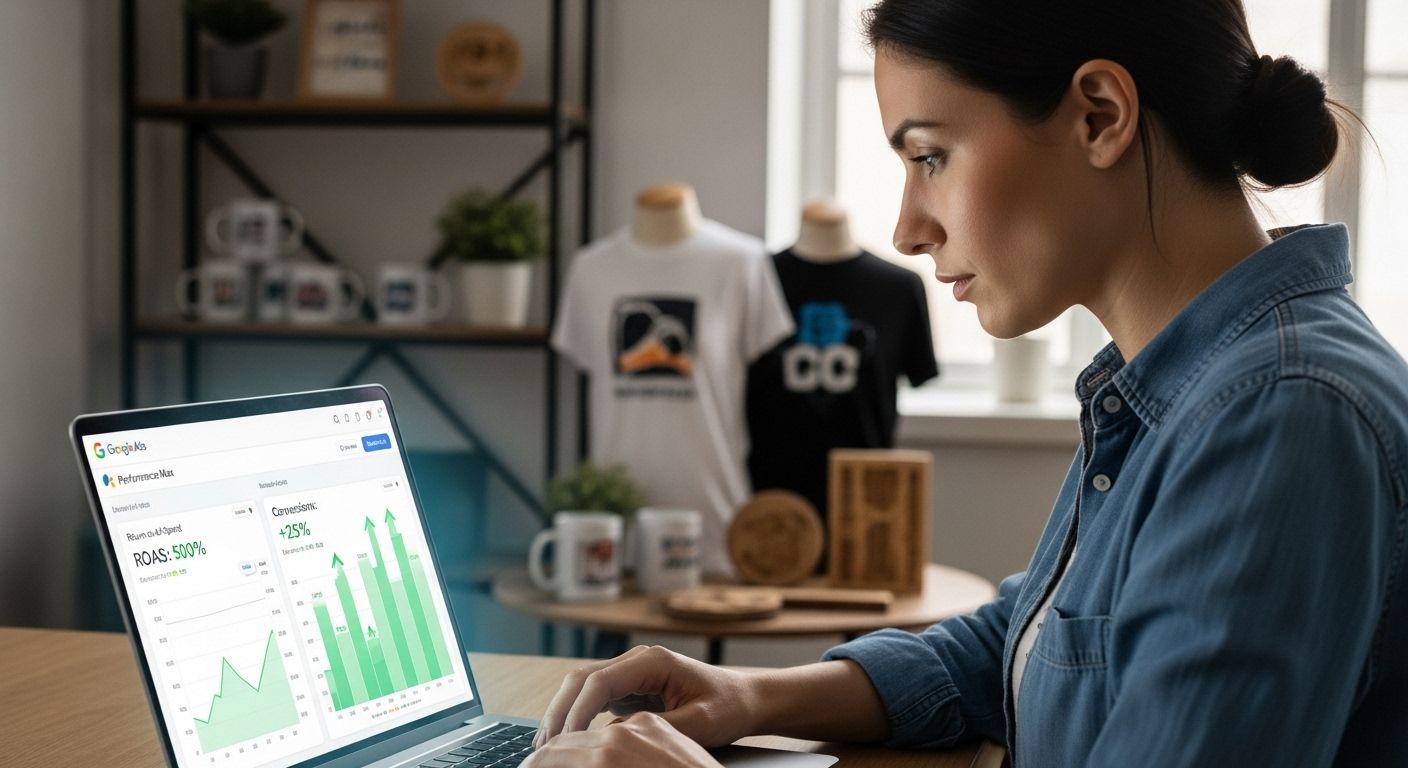
Embrace the AI revolution with Performance Max (PMax)

Performance Max (PMax) is Google's all-in-one, goal-based campaign type. It allows you to access your entire Google Ads inventory—YouTube, Display, Search, Discover, Gmail, and Maps—from a single campaign. As Miles McNair, CEO at PPCsavvy, stated in Search Engine Journal, “Performance Max is a full-funnel campaign type that's just going to keep on getting more powerful.”

The key to PMax is feeding it high-quality "assets." This includes headlines, descriptions, images, logos, and videos. For example, if you want to promote your best-selling custom t-shirts, you would provide Google with:

  • Videos: Short clips of people wearing and enjoying the t-shirts.

  • Images: High-resolution photos of your designs and lifestyle shots of the products in use.

  • Text: Compelling headlines and descriptions that highlight unique materials, designs, or a call to action.

Google's AI then mixes and matches these assets to create ads and automatically places them where they are most likely to convert. Fashion retailer Princess Polly famously used this approach to achieve a 129% increase in conversions while hitting their ROAS goal.

Build a full-funnel strategy that nurtures customers

While PMax is a powerful full-funnel tool, it's also beneficial to think about your customer's journey in distinct stages and use specific campaigns to address each one. This approach, outlined by experts at Tinuiti, ensures you're building brand affinity, not just chasing the final click.

1. Top of funnel (TOFU) - awareness: At this stage, customers may not even know your brand exists. Use YouTube and Demand Gen campaigns with engaging video content to introduce your products and story to a broad but relevant audience.

2. Middle of funnel (MOFU) - consideration: Now, shoppers are actively researching. This is where standard Shopping campaigns shine. According to Think with Google (2026), 60% of global shoppers are more likely to buy if they see a product image in search results. This is your chance to create visually stunning ads for custom posters that stand out against competitors.

3. Bottom of funnel (BOFU) - conversion: These customers are ready to buy. Use branded search campaigns (for people searching your store name) and remarketing lists to bring back visitors who have viewed products or abandoned their carts.

This tiered strategy allows for more control and deeper insights. To truly make it effective, you can deepen your strategy with personalized marketing tips that tailor messaging to each stage of the funnel.

The unsung hero: Your Google Merchant Center product feed

Your product feed is a file that contains all the critical information about your products—titles, prices, images, availability, and more. It’s the engine that powers your Shopping and PMax campaigns. A poorly managed feed can lead to ad disapprovals and wasted spend.

The first step is connecting your ecommerce store, such as one built on Shopify, to the Google Merchant Center. From there, you must regularly monitor the "Diagnostics" tab. As noted by experts at Optmyzr, this is where Google flags common issues like price mismatches, broken image links, or policy violations.

For creators using production on demand, accuracy is paramount. For example, when you market personalized mugs for gift-giving seasons, your feed must clearly state production and shipping times to set correct customer expectations and maintain a healthy account status. Treat your product feed not as a one-time setup, but as a living document that requires ongoing attention.

Shopify and Google Analytics comparison

Practical tips for advanced campaign management

Once your foundation is solid, you can implement these advanced strategies to further refine your campaigns and maximize your return.

Strategic inputs: The new role of the advertiser

The shift to AI-driven campaigns requires you to think like a strategist, not a technician. Search Engine Land highlights that success in 2026 and beyond depends on the quality of the strategic inputs you provide. This includes:

  • Audience signals: Give PMax a head start by providing it with your best customer data. This can include remarketing lists of past website visitors, customer lists of previous buyers, or custom segments based on search activity.

  • Business goals: Instead of setting manual CPCs, you set a target goal, like a specific return on ad spend (ROAS). The formula is simple: ROAS = (Revenue from ads / Cost of ads). If you spend $100 on ads and generate $500 in sales, your ROAS is 5x. This is a primary KPI for measuring profitability.

  • Creative excellence: Continuously refresh your creative assets. Test new images, videos, and ad copy to prevent ad fatigue and discover what resonates most with your audience.

You can learn how to track your ad performance with Shopify analytics and other tools to make informed decisions about your goals and budgets.

Leaning into generative AI for creative at scale

Google is rapidly integrating generative AI into its ads platform. As announced on the Google Blog in 2026, advertisers can now provide a URL, and Google’s AI can generate headlines, descriptions, and even image concepts. While this technology is still evolving, it offers creators a powerful way to brainstorm and scale ad creation. You can use a tool like Canva to create your core brand visuals and then use Google's AI to help craft compelling copy and test variations, saving you valuable time.

Start your own business with Gelato. Sign up for free today

mobile hero

Frequently asked questions (FAQ)

1. What are the best Google Ads tactics for a small ecommerce business?

For small businesses and creators, the best tactic is to start with a single Performance Max campaign. It maximizes your reach across all of Google's channels with a limited budget and requires less manual management. Focus on creating high-quality assets and a perfectly optimized product feed.

2. How much should I spend on Google Ads for my store?

There is no magic number. Start with a small daily budget you are comfortable losing (e.g., $10-$20/day) to gather data. Focus on achieving a profitable ROAS. Once your campaigns are profitable, you can scale your budget gradually.

3. What is Performance Max and why should I use it?

Performance Max is an AI-driven, goal-based campaign type that runs ads across all of Google's properties (Search, Shopping, YouTube, etc.) from one setup. You should use it because it simplifies campaign management, leverages Google's powerful automation to find converting customers, and often delivers a higher ROAS than managing multiple separate campaigns.

4. How do I measure the success of my Google Ads campaigns?

The most important metric for an ecommerce store is return on ad spend (ROAS). Other key metrics to monitor in Google Analytics include conversion rate, cost per conversion, and click-through rate (CTR).

5. What are the most common mistakes to avoid with Google Ads?

Common mistakes include neglecting the Google Merchant Center feed, using low-quality product images, not providing enough creative assets for PMax, setting unrealistic budgets or ROAS targets, and not installing conversion tracking correctly.

6. How important are visuals for Google Shopping ads?

Visuals are critically important. Data from Google shows that 60% of shoppers are more likely to buy from a brand if they see a product image in search results. Your main product image should be clear, professional, and on a white background, supplemented with lifestyle images in your asset groups.

7. Can I use Google Ads to promote seasonal products?

Absolutely. Google Ads is perfect for seasonal promotions. You can create dedicated campaigns or asset groups that you activate during peak seasons. For example, you can align ad spend with ecommerce seasonality trends to heavily promote custom gifts in Q4 or target niche audiences with eco-friendly tote bags for summer events.

From clicks to customers: Grow your brand with Gelato

Mastering the best Google Ads tactics is no longer about outsmarting an algorithm with manual tweaks. It’s about forming a strategic partnership with AI. By providing clear goals, compelling creative, and a flawless product feed, you empower Google to become your most effective salesperson, working 24/7 to grow your brand. This new paradigm puts the power back in your hands, allowing you to focus on what you do best: creating incredible products that people love. And when it comes to bringing those creations to life, quality and reliability are everything.

Gelato’s production on demand platform ensures that every ad click leads to a happy customer receiving a beautiful, high-quality product. Whether you need to target niche audiences with eco-friendly tote bags or expand your entire collection of apparel and wall art, our global network is ready to produce and ship your orders sustainably and efficiently. Let Google Ads find your audience, and let Gelato delight them.

Share:

Next steps

Grow your ecommerce business with Gelato today