Business Card Size Guide: Standard Dimensions & Templates
Business card size is the first decision in any card design project — and it's also one of the most searched business card questions on Google, with 28,000 monthly searches in the US alone. The reason is practical: get the size wrong and your cards don't fit standard wallets, holders, or Rolodexes. Get it right and you've cleared the first hurdle toward a card that makes an impression.
This guide covers every standard business card size used globally, the speciality formats that are gaining traction in 2026, and the design considerations that change between sizes. For print-on-demand sellers who offer custom business cards, it maps out the size landscape buyers are navigating when they reach your product listings.
Business cards are one of the most consistent, year-round POD products — no seasonal peaks, strong B2B demand, and clear commercial intent from buyers. See our profitable niches guide for where business cards rank in the overall POD opportunity landscape, and our full Etsy POD seller guide for how to position and price them effectively.
- The standard US business card size is 3.5" × 2" (88.9mm × 50.8mm) — this fits all standard wallets, card holders, and card scanners.
- UK and European standard size is 85mm × 55mm — fractionally wider and taller than US standard. Most design templates are interchangeable at this scale.
- Square (2.5" × 2.5" or 60mm × 60mm), mini (2.75" × 1.25"), and rounded-corner are the most popular specialty format trends in 2024–26.
- Bleed area: always design to at least 3mm bleed on all sides. Without bleed, trim lines show white edges on final cards.
- Safe zone: keep all critical text and logos 3–5mm inside the trim line — the 'safe zone' — to survive production variance.
- For digital-first businesses, QR code business cards (linking to a website or portfolio) are the fastest-growing sub-category in 2025–26.
Standard Business Card Sizes by Country
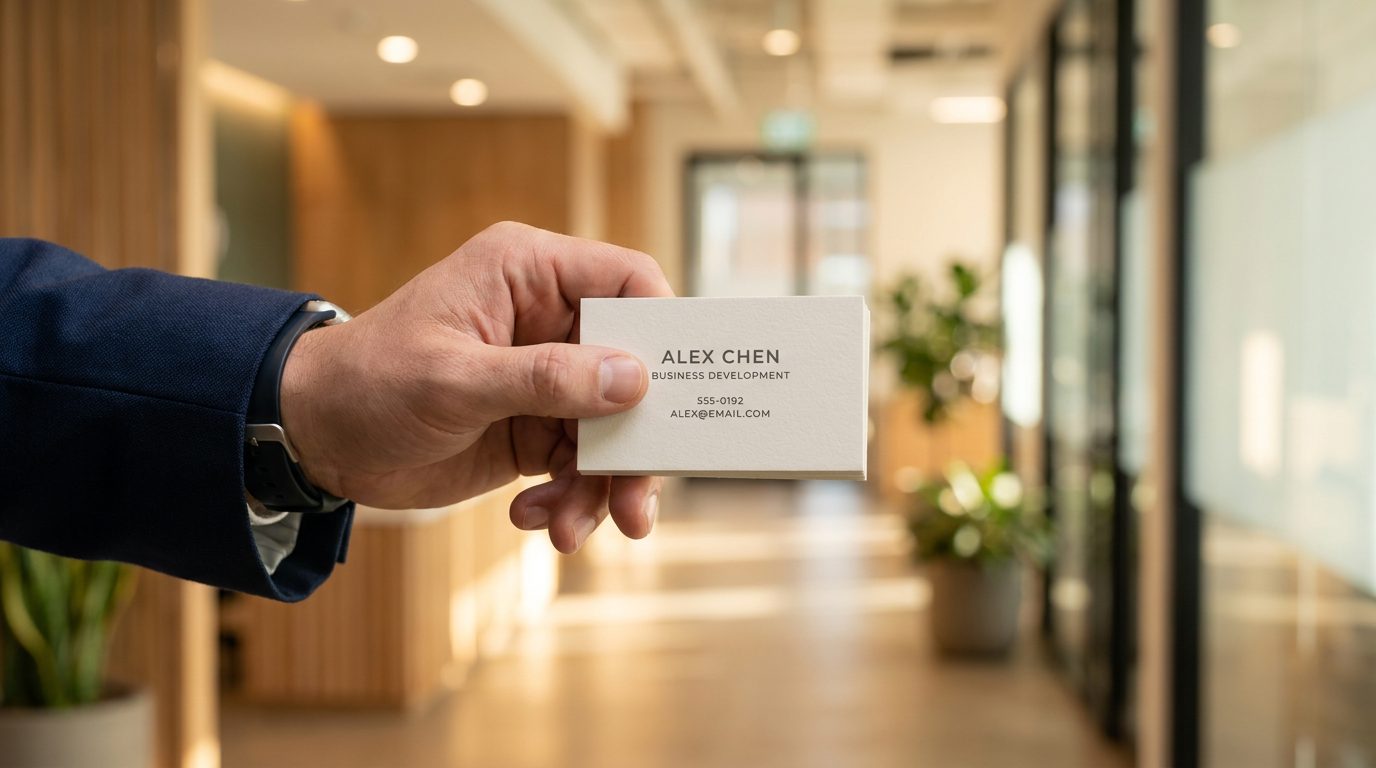
Business card sizes are not globally standardised — different countries use different default dimensions, with most being close enough that a single design can be adapted across markets. Here are the key standards you'll encounter:
USA / Canada — 3.5" × 2" (88.9mm × 50.8mm). The North American standard. Fits all US card wallets and holders. The most common size globally after the European standard.
UK / Europe — 85mm × 55mm (3.35" × 2.17"). The ISO CR80 standard used across the UK, EU, and much of the world. Slightly wider and taller than US cards but interchangeable in most holders.
Japan — 91mm × 55mm (3.58" × 2.17"). Slightly longer than the European standard. Japanese business card exchange (meishi koukan) is a formalised ritual — card design and quality matter significantly here.
Australia — 90mm × 55mm (3.54" × 2.17"). Close to the European standard; slightly longer than the US format.
China — 90mm × 54mm (3.54" × 2.13"). Very close to European standard. Often printed double-sided with Chinese on one side and English on the other for international business.
India — 88.9mm × 50.8mm (3.5" × 2"). Same as US standard — a legacy of US business influence and card stock availability.
Russia / Eastern Europe — 90mm × 50mm. Slightly narrower than the European standard; uses the ISO format but with reduced height.
Practical note for POD sellers: If you're selling business card templates or printed cards, design to the US standard (3.5" × 2") OR the European standard (85mm × 55mm) — your two largest markets. Label clearly which standard your listing uses. International buyers purchasing from a US store often assume US sizing and are surprised to receive a European-spec card.
Specialty Business Card Formats & Trends in 2026
Specialty formats have grown from a niche design choice to a mainstream one in 2024–26. The drivers: a saturated standard-card market where differentiation is difficult, and buyers who want their card to stand out in a wallet or on a desk. Here are the formats gaining traction:
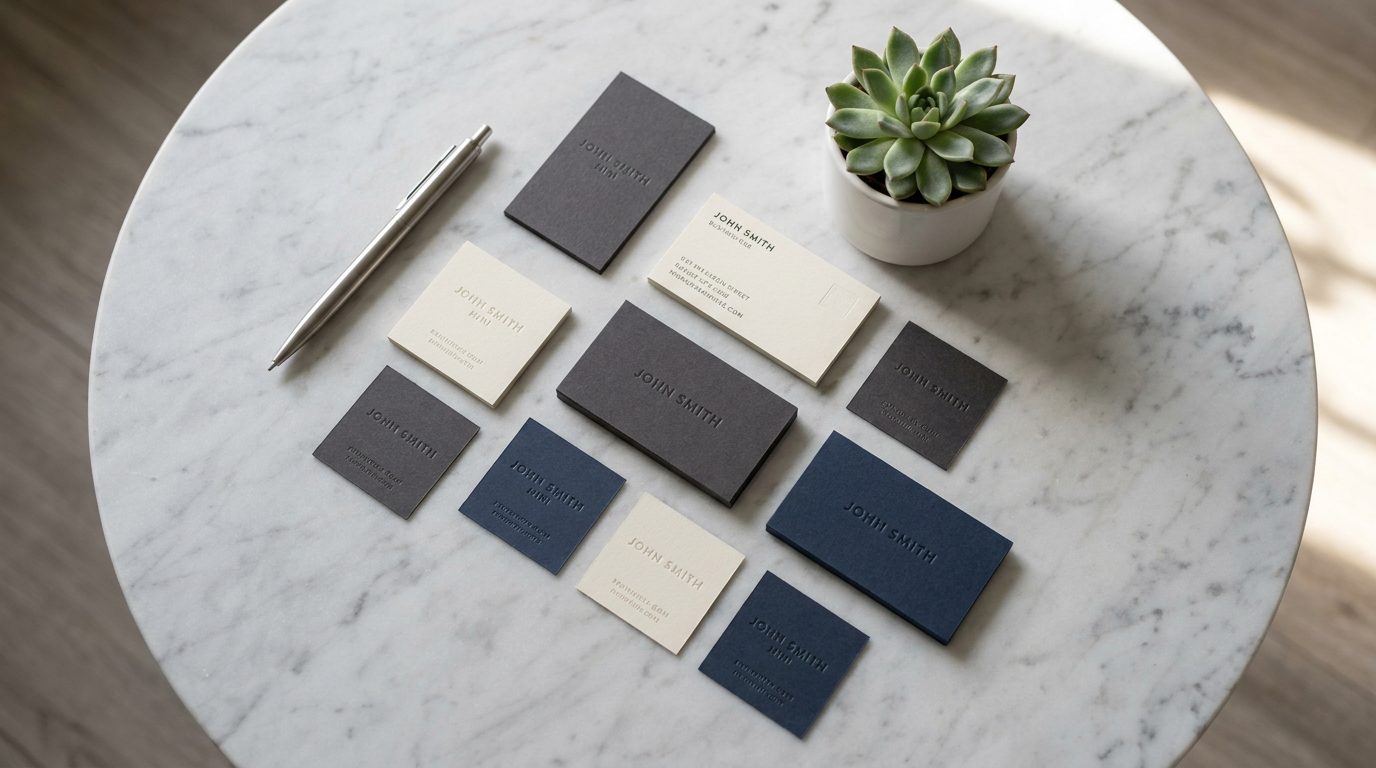
Square cards — 2.5" × 2.5" (63.5mm × 63.5mm) or 55mm × 55mm. The most popular specialty format. Stands out immediately in any stack of standard cards. Particularly popular with creative professionals, photographers, and luxury brands.
Mini cards — 2.75" × 1.25" (70mm × 32mm) or similar. Half the height of a standard card; often used as loyalty cards, appointment reminders, or minimalist brand tokens. The Moo 'mini card' popularised this format.
Rounded corners — standard dimensions with radius-cut corners (typically 3mm or 5mm radius). Not a different size, but a significantly different feel in the hand. Widely used in tech, creative, and lifestyle brands.
Slim / landscape elongated — 3.5" × 1.5" (90mm × 38mm). Elongated landscape cards with a distinctive shape. Works well for simple text-only designs; less versatile for complex layouts.
Die-cut custom shapes — cards cut to a specific custom shape (a camera, a leaf, a product silhouette). Premium production cost; exceptional first impression. Best used by brands with a strong visual identity.
Folded cards — a double-sided card that folds to standard size, giving 4 printable surfaces instead of 2. Common in industries where more information is needed (medical professionals, attorneys, consultants).
QR code cards — standard-size cards with a prominent QR code linking to a website, portfolio, LinkedIn, or vCard. The fastest-growing business card format in 2025–26; entire 'smart business card' services have built on this concept.
Custom Business Cards — Designed & Printed On Demand
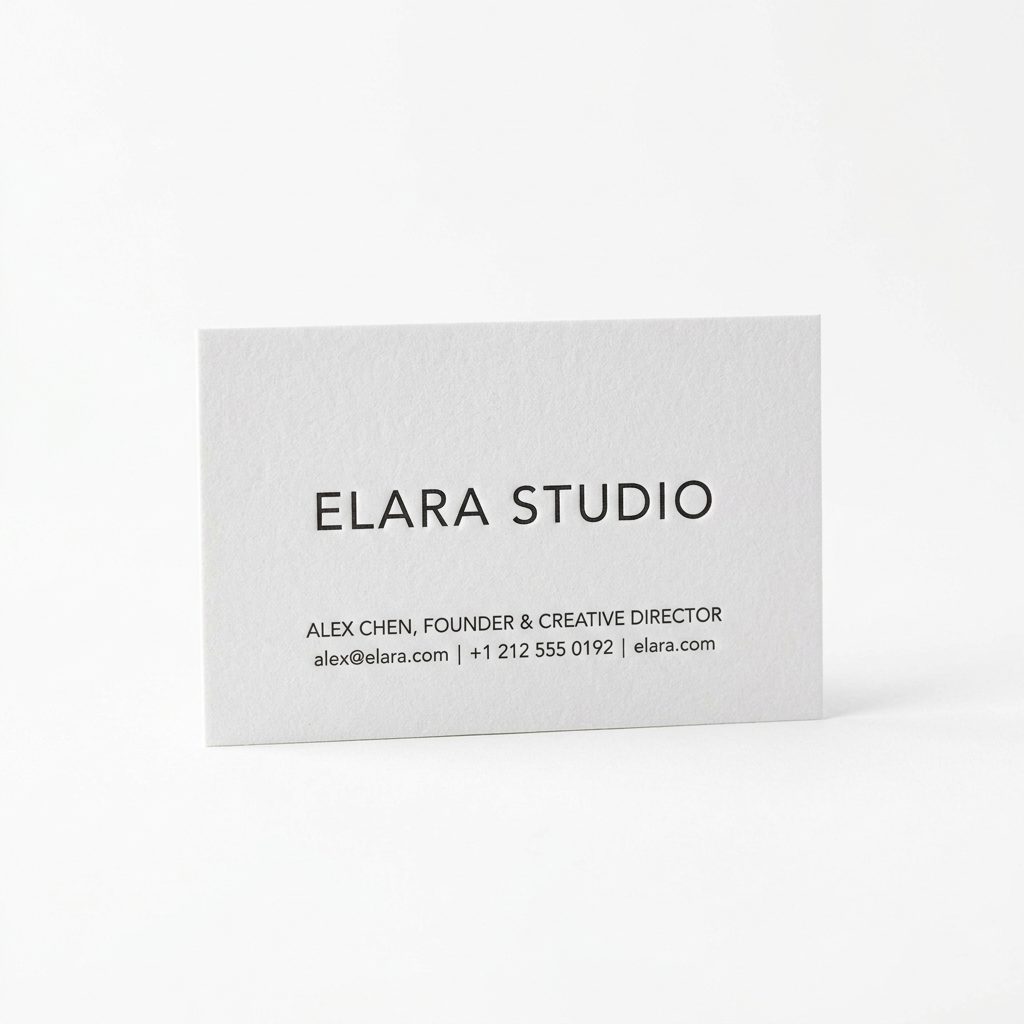
Design premium business cards in standard or specialty sizes through Gelato. Choose from single-sided or double-sided, matte or gloss finish, standard or rounded corners. Printed locally and shipped globally — no minimum order required.
Design business cards →Business Card Design Specifications: What You Need to Know
Business card design specs are where most first-time designers trip up. These are the technical requirements you must meet for clean, professional output:
Bleed — add 3mm (0.125") of design beyond the trim line on all four sides. Without bleed, any slight variance in cutting leaves a white paper edge along one or more sides. Always design with bleed.
Safe zone — keep all critical text, logos, and key design elements at least 3–5mm inside the trim line. Content that runs too close to the edge may be cut off in production.
Resolution — minimum 300 DPI (dots per inch) at final print size. Lower resolution creates visible pixel artifacts in text and fine-line elements. 400–600 DPI is recommended for photography-heavy designs.
Colour mode — use CMYK, not RGB. Screen colours display in RGB; print output is CMYK. An RGB design submitted to a print lab will have its colours automatically converted, often losing vibrancy. Design in CMYK from the start.
Fonts — convert all fonts to outlines/curves before submitting files. This prevents font substitution if the print lab doesn't have your exact font installed. A missing font renders as a default substitute.
File format — PDF (print-ready) is universally accepted; TIFF is a reliable alternative. AI, PSD, and INDD files can be used at print-ready resolution but are more prone to font and link issues. Avoid JPEG for business cards — compression artifacts are visible in text.
Standard Template Dimensions (with Bleed)
Use these dimensions when setting up your design canvas — they include the 3mm bleed area:
US standard with bleed: 94.9mm × 57mm (3.75" × 2.25") — trim to 88.9mm × 50.8mm
European standard with bleed: 91mm × 61mm — trim to 85mm × 55mm
Square with bleed: 69.5mm × 69.5mm — trim to 63.5mm × 63.5mm
Mini card with bleed: 76mm × 38mm — trim to 70mm × 32mm
Japan standard with bleed: 97mm × 61mm — trim to 91mm × 55mm
Australia standard with bleed: 96mm × 61mm — trim to 90mm × 55mm
Business Card Finishes & Materials in 2026
The finish of a business card communicates as much as the design. Here's how the main finish options perform in real-world networking and business contexts:
Matte laminate — the current premium standard. Smooth, non-reflective surface; feels luxurious in hand; takes spot UV and foil overlays well. The default choice for professional and luxury brands in 2026.
Gloss laminate — high shine, vivid colour reproduction. Feels premium at first but shows fingerprints and scuffs quickly. Best for photography-heavy designs where colour saturation matters more than surface feel.
Soft-touch (velvet) laminate — a slightly rubberised matte surface that feels noticeably different from standard finishes. Highest tactile impact; commonly used for luxury and fashion brands.
Uncoated (no laminate) — the feel of high-quality paper stock with no laminate. Accepts handwriting and stamps easily; often used for appointment cards, hospitality cards, and brands with a craft or artisan aesthetic.
Spot UV — a gloss UV coating applied selectively over a matte base, creating a texture contrast between the matte background and the UV-highlighted design element (often a logo). Sophisticated; noticeably more expensive to produce.
Foil print — metallic foil (gold, silver, rose gold, copper) applied to specific design elements. The premium card option; creates an immediate impression of quality. Significantly higher production cost.
Paper Weight: What GSM Means for Business Cards
300–350 GSM — standard business card weight. Substantial enough to feel professional; lightweight enough to carry 50+ in a standard card case.
400–450 GSM — premium weight. Noticeably thicker; communicates quality immediately. The choice for professional services (law, finance, medical) where credibility signal matters.
600–700 GSM — ultra-premium or double-thick. Sometimes used for letterpress or debossed cards. High impact; difficult to fit in standard card holders — best used intentionally.
Start selling custom business cards on Gelato.
Business cards are a year-round, high-margin POD product with strong B2B demand. Upload your designs, set your prices, and Gelato handles production and fulfilment — no inventory, no minimum orders, global delivery.